Why our best ideas come at the gym

Happy Saturday friends! Megan here.

Here’s an amazing fact. Next Sunday is the Gains and Brains first birthday.
We’re cooking up some things to celebrate - more on that next week. But to start, we’re kicking off Sweat with Pride next week, raising money for rainbow organisations. If you want to join our team, let us know, and get on board with a little activity every day. (Or, you can just donate for a worthy cause.)
It’s pretty amazing that we have managed to do this for a whole year! We’re so grateful you’re here and for the engagement and questions you send in. Legends, all of you.
Speaking of questions, we’re taking one from Jeremy this week: Hey have you done a newsletter about the connection with our brain in exercise? le why an exercise feels harder when we add something neurological - like catching a ball while doing squats. Or why we feel tired after an intense meeting. Or why some people (like me!) enjoy exercise which involves more than just pushing weights.
There is a rule in my household. It started as one of those unspoken things, and then it became explicit.
When you come home from work, you’re allowed to vent for as long as you need to. Rant and rave, be as unconstructive as feels good. But then, when you’re done, you’re done. No stewing over it and then piping up with “and another thing he said” and starting again.
We go about our evening, have dinner, watch tv, read, play games, whatever we’re doing.
And often, close to bedtime, we will find ourselves sitting on the stairs, saying “OK, but what if I [actual solution to the problem goes here].”
As always, Carl can talk about the actual science here, but the way I think about it is this: thinking about a problem is the worst way to solve it. Our brains do better work when we’re not consciously thinking about it.
This shows up for me in the gym too. I can’t tell you how many times I have gone to the gym after a really hard day, loaded (probably too much) weight onto a barbell, and lifted so heavy I couldn’t think.
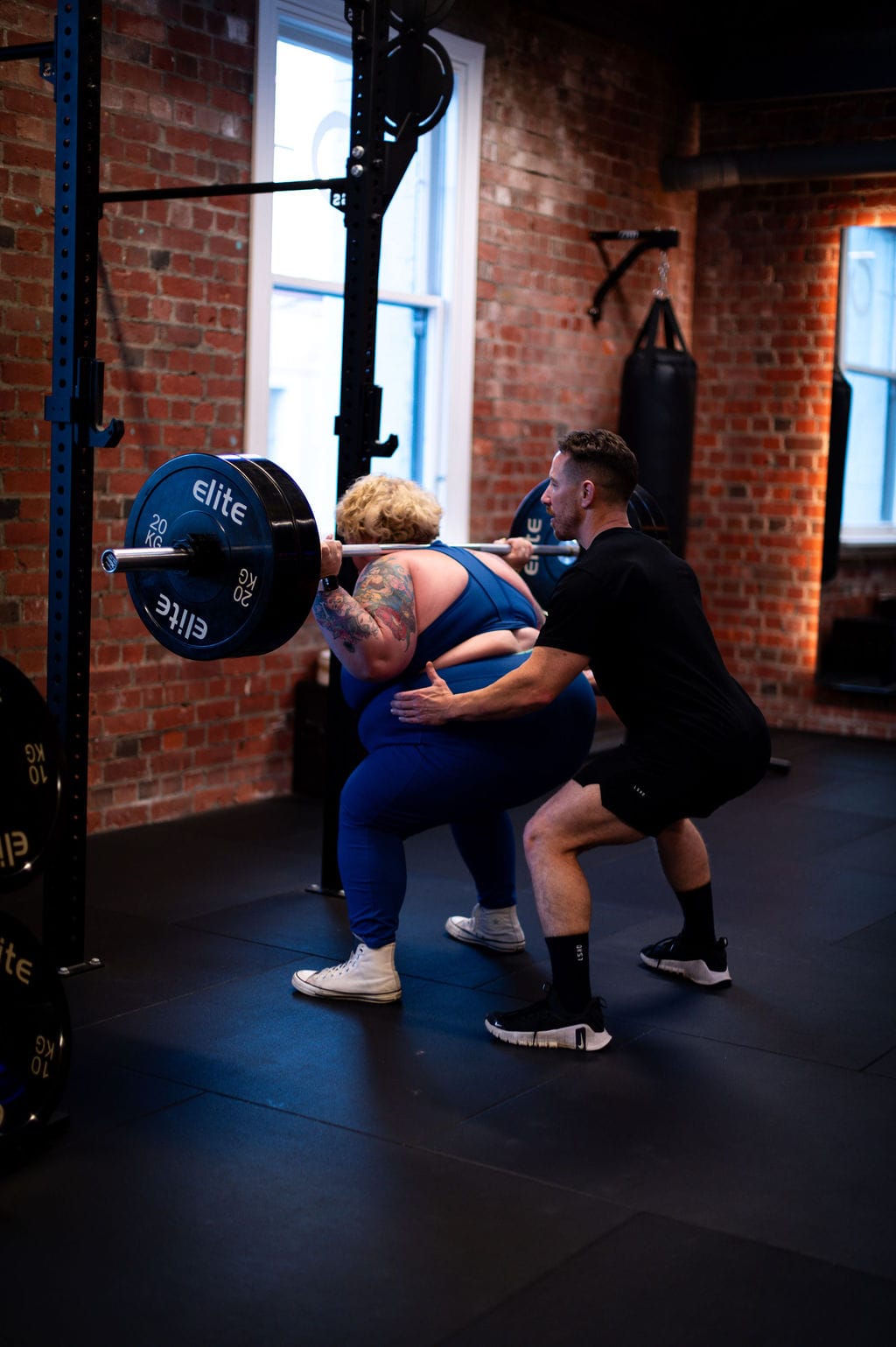
When you’re lifting enough weight over your head that dropping it feels unsafe, it’s impossible to worry about that one guy in the meeting who stole your idea. And 30 minutes later, you come up with the best way to handle him because your brain didn’t turn off while you were focussed on lifting, it worked away in the background.
OK, a little science from me, as a treat. This is called the Default Mode Network. It’s what happens when you’re not focused on the outside world. It’s why good ideas always come in the shower. It’s why putting down your phone and being bored is good. (Gains & Brains bestie Ruby wrote about it here) It’s why your brain can process your day while you’re trying not to fall over your feet in boxing class.
Here’s another thing I know. Your brain is the main consumer of glucose. It’s about 2% of your body weight, but uses about 20% of your glucose-derived energy. In an intense meeting, she’s working hard!
So it stands to reason that exercises that are using your brain as well as your muscles and cardio-vascular system would be more tiring.
Without telling me, Carl did this to me this week. When I showed up to our session, he asked what I wanted to work on, and threw out “new things, maybe?”
Perhaps with this newsletter in mind - I don’t mind being a test subject at all - he put me through my paces with a bunch of unfamiliar compound movements for 30 minutes. Lunges with twists and a viper and dumbbell curls with the kind of form I raise my eyebrows at normally. Table tennis.
It was harder than it should have been. Even without heavy weights, my brain was having to work hard, and it was a lot of fun.
So, Carl…explain. Just torture, or something more involved?
Carl here
Thanks Jeremy, these are great questions, and Megan's setup gives me a lot to work with! Firstly, you are both doing great things in the gym and we are about to explore why what you are doing is great for your brain and body. Let’s also be clear, I'm not a neuroscientist, so this is how I understand it through an exercise physiology and psychology lens at this moment in time.
Let me start with what Jeremy named: why does adding a neurological element make exercise harder? And then I want to build on Megan's Default Mode Network explanation, because the full science is even more interesting.
Your brain and body are competing for the same resources
When you combine a physical movement with a cognitive demand like tracking a table tennis ball, learning a new pattern, or catching something mid-squat, you are not just doing two things at once. You are asking your brain and body to share a genuinely limited pool of attention and energy.
Researchers call this the dual-task cost. It shows up in how accurately you move, how quickly you react, and how hard the effort feels, even when the weight is light (Beurskens & Bock, 2012, Journal of Aging Research). This is exactly why Megan found last week's session harder than her usual heavy lifting. Her nervous system was doing significantly more work than the normal gravy tin lifting!
New movements literally remodel your brain
When a movement is well-practised, your brain handles it on autopilot. Efficient brain structures take over with very little conscious effort. But when a movement is unfamiliar, your brain's planning and decision-making centre (the prefrontal cortex, roughly behind your forehead) has to stay switched on the whole time, supervising every rep, catching errors, and figuring out sequencing.
Learning a new motor skill produces real, measurable changes in brain structure such as building new synaptic connections in networks that control movement (Dayan & Cohen, 2011, Neuron). Your brain is being rebuilt in real time and it costs energy, which is why novelty is tiring in a way that familiarity simply isn't.
Here is the exciting part! Complex and new movement also drives the release of brain-derived neurotrophic factor (BDNF), essentially a fertiliser for brain. Aerobic exercise raises BDNF on its own (especially high intensity and for prolonged periods), but combining it with skill-based, cognitively demanding movement produces an even stronger response (Huang et al., 2014, Neuroscience and Biobehavioral Reviews). This is one reason varied, complex training appears to support long-term cognitive health.
So, if you want the biggest brain benefit from your training, mix in something you are not yet good at. A new mode of exercise, an unfamiliar movement pattern, a coordination challenge or even couple it with a cognitive task. The discomfort of not knowing what you are doing is the signal that something valuable is happening. For me personally, this has completely reshaped my experience with failure. I know now that when I am failing at a new skill or movement, that is where I get all of these fantastic cognitive gains and a nice little healthy squirt of brain fertiliser!
Why an intense meeting leaves you exhausted
Megan is right that the brain uses around 20% of the body's energy at rest (Raichle and Gusnard, 2002, PNAS). But sustained mental effort, especially the kind that involves social judgment, uncertainty, or emotional regulation, degrades the brain's performance in ways that closely parallel physical fatigue (Van der Linden et al., 2003, Journal of Experimental Psychology: Applied). This is not metaphorical tiredness. Your brain after a hard meeting genuinely functions differently than it did beforehand. It needs recovery time, just like a muscle does!
This is a state in which many of my clients come to me to be honest! I usually start with connecting with them, then something familiar and then something playful, then we reassess (together) and if we are good to go then we will train with some intensity, if not then we may have a more gentle movement session (there is always something we can do that will benefit).
Building on Megan's Default Mode Network: the full picture
Megan's description of the DMN as the brain's background processing mode is a great starting point. The DMN is a set of interconnected brain regions that becomes more active when we are not focused on the outside world. It is active during daydreaming, memory retrieval, and the kind of loose, wandering thought that happens in the shower (Buckner et al., 2008, Annals of the New York Academy of Sciences).
Where the story gets richer is in what actually produces the insight. The DMN creates the open, associative mental state, but the "aha" moment itself appears to involve a separate burst of activity that fires when two previously disconnected pieces of information suddenly click together (Kounios and Beeman, 2014, Trends in Cognitive Sciences).
The fuller explanation is what researchers call incubation. When you stop consciously grinding on a problem, you remove the mental fixation that was actually limiting your thinking. Intense, focused effort can lock you into one way of seeing a problem. These three things, the DMN, incubation, and the moment of insight, are all well supported in the research individually. The way they interact is still being worked out by scientists, but as a working model for understanding your own brain, they fit together like this: the DMN creates the open state, incubation allows the broader search, and then the insight fires.
Most incubation research involves quiet rest, but intense exercise likely achieves something similar by capturing attention so completely that the conscious rumination simply stops. Stepping away through a shower, distraction, or an exercise session where dropping the weight genuinely demands your full attention, allows your brain to search more broadly across everything it already knows (Sio and Ormerod, 2009, Psychological Bulletin).
Megan's heavy lifting captured her attention so completely that the conscious rumination keeping her stuck had nowhere to run. The staircase moment happens because her brain was finally free to look elsewhere.
The shower does not make you smarter, it makes you stop getting in your own way. The felt experience of this is hard to improve on, even if the anatomy is a little more complicated. As Ruby put it to me recently, and I am paraphrasing here “if there is less stimulation coming in from the outside world, there is more space for the brain to work on what is already in there”.
What this means practically
Jeremy, you are on to it as the neuroscience backs up what you already enjoy! Complex, skill-demanding training activates more of the brain, creates more neuroplastic change, and produces a stronger BDNF response. Novelty is also intrinsically motivating at a neurological level (Bunzeck and Düzel, 2006, Neuron\), which may explain why people who train this way tend to stick with it.
Some ideas worth trying could be:
Adding a coordination challenge to a familiar exercise (a balance element, a reaction component, a new grip or stance), rotate in a new skill every few weeks, or simply do something you are genuinely not good at yet. The cognitive load is the feature, not the bug.
Learn a new physical skill in the gym as a brain/body warm up. Learn juggling, reactive self ball games, getting down and up off the ground in different ways or table tennis like Megan!
And on the meeting fatigue, treat mental effort like physical effort. Scheduled recovery, a walk, a genuine break without a screen, or yes, a training session that demands too much attention to worry, is not laziness. It is how the brain restores the capacity to do hard things again. I think we can come back to this alone as a separate post in a future newsletter as there is some cool research here!
As for Megan being my test subject: the new movements, the unfamiliar loading, the table tennis, all of it was cognitively demanding in exactly the ways the research suggests. I feel like this has given me permission to be more creative in our sessions moving forward. Or to put it less charitably, I now have peer reviewed justification for any obfuscation I throw at her...