
The view from the plateau
Happy Saturday friends. Some admin before we get into this week’s newsletter.
Firstly, as you may already know, you can sponsor Carl and I for Sweat with Pride over here. We’re both aiming for 42 minutes of sweating a day, which feels like a lot when the weather is like it is in Wellington right now.
Secondly, HAPPY BIRTHDAY TO US!
We’ve been doing this for a year, and we’re so grateful you’re here with us. We love your questions and your comments and when people stop us in the gym to tell us something in a newsletter sparked something for them. It’s genuinely excellent.
To celebrate, we’re going to give away…our time and expertise. An hour of coaching with Carl to break through a plateau (more on that in a minute), figure out how to get started, design a programme or just learn from someone grounded in science and knowledge about bodies and fitness. And/or an hour of career coaching with Megan: how to deal with that difficult co-worker, how to get to the next step in your career, how to be resilient in the face of all the uncertainty there is out there right now.
We will be sharing how to enter over on Insta, but if you’re not on the socials (we salute you) flick us an email to enter. We’ll do a draw at the end of the month.

OK, on with the show!
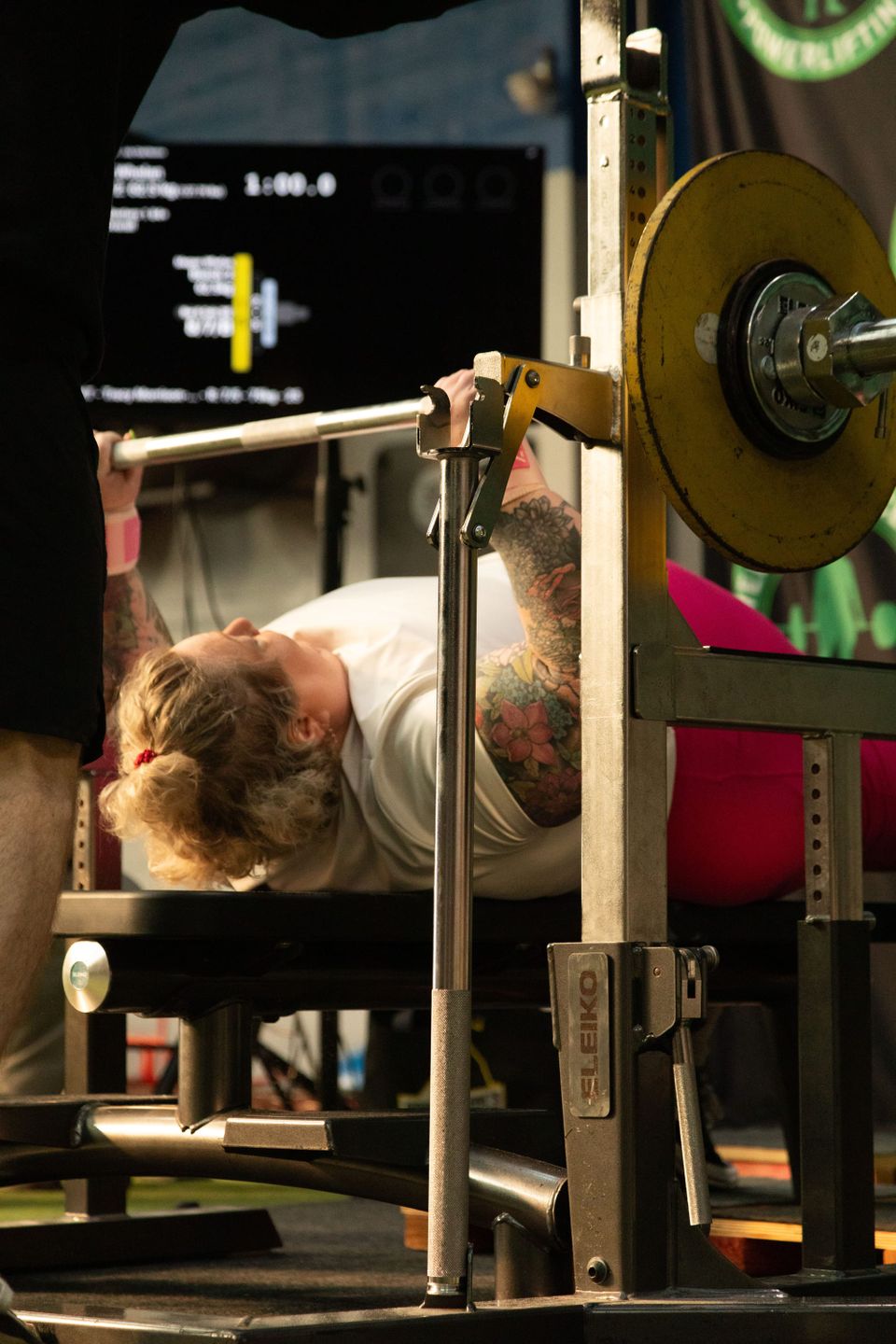
Also over on Instagram I have had a spate of videos in my feed this past couple of weeks of women vowing that 2026 will be the year they get their 130lb bench press. And every time I have three thoughts.
- How much is 130 pounds in real money God the imperial system is stupid.
- I really should stop following elite and world record-holding lifters. If 130 pounds (59kg) is the goal, I have achieved that, and maybe I should stop comparing myself to people who are doing this at a much higher level than me.
- Man, I have been hovering around 60kg for years and I can’t smash through it.
Let’s talk about that last one.
When people start lifting, there’s often what we call “newbie gains.” The weights start flying up, and week-to-week you’re adding 5, even 10kg to your lifts. You’re tossing off new PBs every second session.It feels great and you feel like the strongest person alive.
And then it slows down. It gets harder and hard to add weight or reps. It feels like you will never push past it.
I’ve been on this plateau for about three years. I’ve managed 65kg a couple of times, but not consistently, and not cleanly, and certainly not in a way that would be a good lift in a powerlifting competition.
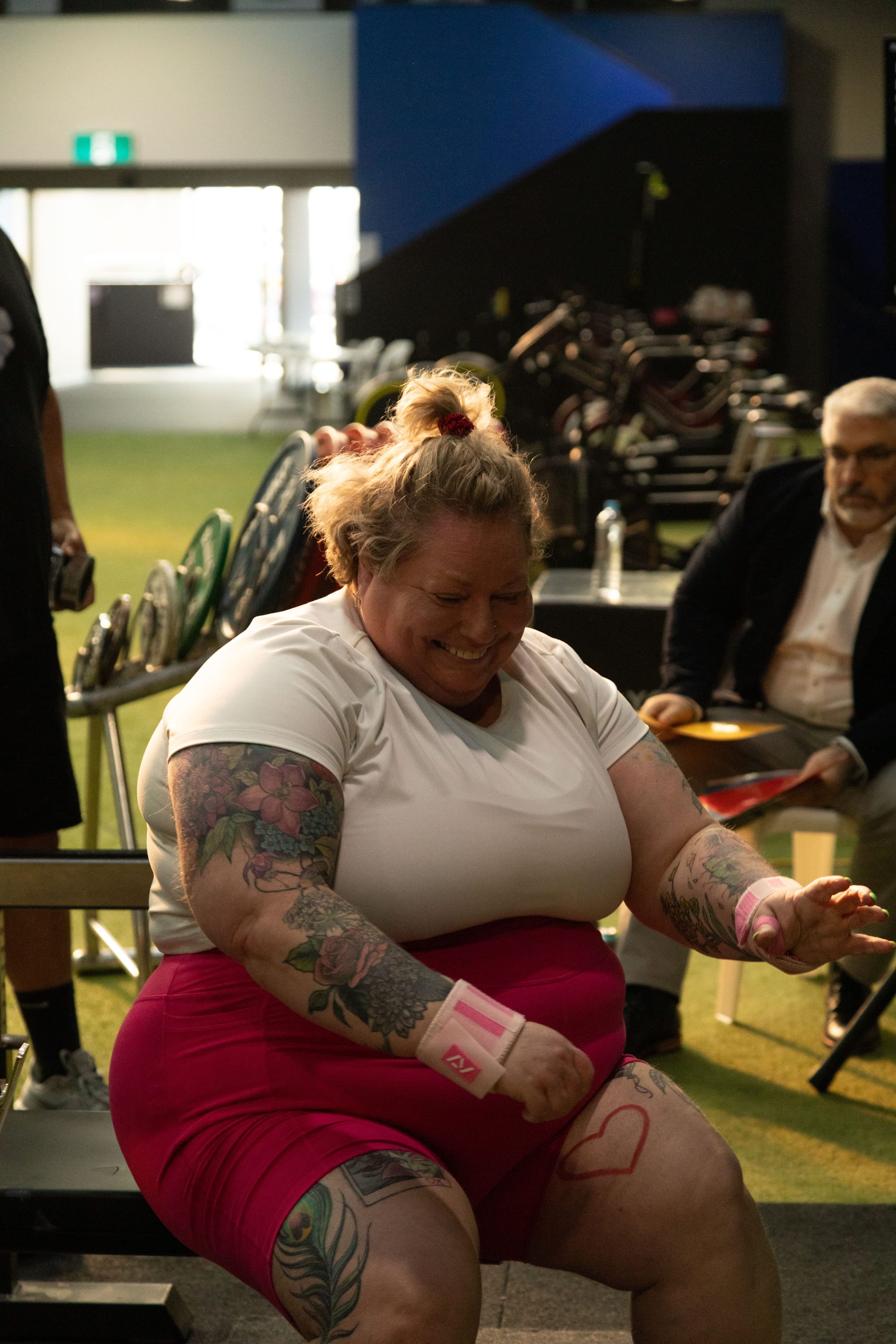
There are absolutely things we can do about this - refine the technique, lots of accessories. Carl has made me do an exercise where I load the bar way heavier than I can lift, and just lift it out of the rack - not actually lowering it to my chest. It’s real work, and it gives me the good brain feeling of using my muscles hard.
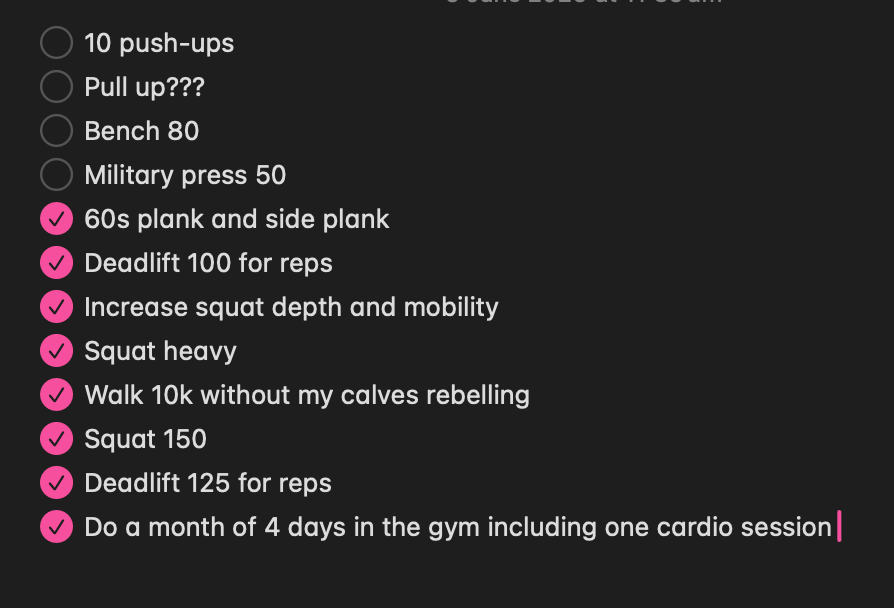
It can be frustrating though to shift the rewards you get from lifting. I’ve had “Bench 80kg” in my notes app for two years now. And I am not even close - that’s demotivating more than anything. And this isn’t specific to lifting - maybe the plateau is your 5km running time, or the distance of your drive in golf.
The bit that is scary about a plateau is: what if 65kg is all I am capable of? What if my pecs and shoulders aren’t actually built to lift more than that? What if I never get past this, and that notes app goals list never gets its full complement of ticks.
I don’t actually believe that that’s true, but it’s what the voices in my head like to tell me.
And yet. I show up, and I do my lifts and I incline press 15kg dumbbells to remind myself that the point isn’t just the number on the barbell. It’s just making the weights go up at all.
So, Carl. Are the voices in my head right? Am I physiologically unsuited to benching more than 60kg? Or do I just need to watch more of Jen Thompson’s videos and work on my technique?
Carl here
Megan, the voices in your head are probably wrong! Let me explore why plateaus happen, what is actually going on in your body, and what we may be able to do about it.
80% of the gains in the first 20% of the time, 20% of the gains in the final 80% of the time…
How great are the newbie gains?! But then the results start to slow (and sometimes the motivation too). When you first start lifting, your nervous system is doing most of the work. Your brain is rapidly learning to recruit more muscle fibres, coordinate movement patterns, and sequence muscle activation efficiently. This neural adaptation happens fast and produces those early jumps in strength that feel almost effortless. The weights go up because your brain is getting better at using the muscle you already have (Behm et al., 2021, Frontiers in Physiology).
Once that neural adaptation matures, actual structural changes in the muscle have to drive progress. That is slower, harder, and much more sensitive to everything else going on in your life. This is not failure, It is just a different phase with different rules and it can also be when it gets fun! We will get to the solutions soon!
Are you physiologically unsuited to benching more than 60kg?
Almost certainly not, but let me give you an honest answer on genetic and age related factors because they are realistic factors and worth understanding rather than dismissing.
Genetics do influence your ceiling. Factors like limb length, muscle insertion points, chest depth, and fibre type distribution all affect how a lift feels and how much mechanical advantage you have (Erskine et al., 2014, Exercise and Sport Sciences Reviews). Some people are structurally better suited to the bench press than others. This is not an excuse, it is just anatomy. The same factors apply to other exercises or exercise modes also.
Age matters too. As we age, maintaining and building muscle requires more deliberate stimulus and recovery than it did when you were younger (Tipton, 2015, Experimental Physiology). Hormonal changes affect the rate of muscle protein synthesis. Progress is still absolutely possible, but it just demands more precision. Power and strength are start to drop of also.
But here is the important thing: none of these factors necessarily put a ceiling at 65kg for you. They might shape what your ultimate ceiling looks like, but you may not be near it. It is almost always training, recovery, or programming factors.
Training factors: what actually causes a plateau
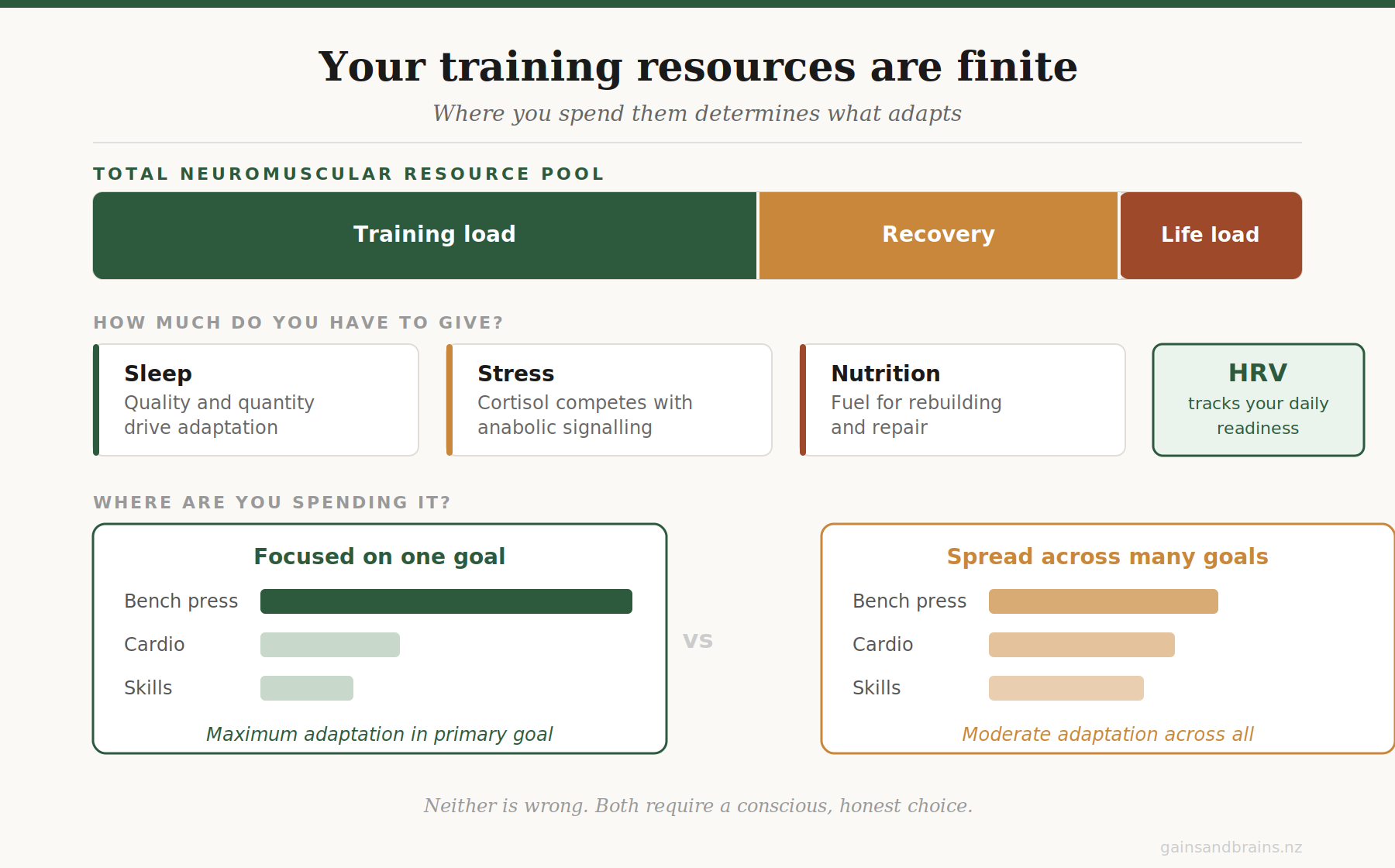
At its core, a plateau is a resource problem.
Your body has a finite pool of energy and a finite capacity to absorb and adapt to neuromuscular stress, the combined cognitive, neural, and physical load that training places on your system. Progress happens when you apply the right stimulus, in the right amount, to a system that has enough left in the tank to respond to it. When any part of that equation is off, adaptation stalls.
There are two questions worth asking. First, how much do you actually have to give? This is largely shaped by your recovery, your sleep, your stress load, and everything else going on outside the gym, which we will come to shortly. Second, where are you spending what you have?
This second question is the one most people skip. Training resources spent on one goal are not available for another. Neural adaptation to a new movement pattern, hypertrophy in one muscle group, cardiovascular development, skill acquisition, these all draw from the same pool. After my triple challenge last year I learned this the hard way. You cannot be genuinely excellent at everything simultaneously. The body does not budget that way.
This is where honest prioritisation becomes a training tool in itself. If you want to break through a specific plateau, that goal needs to become the primary destination for your resources, in session design, in recovery allocation, and in how you manage your energy across the week. That does not mean abandoning everything else. It means being clear eyed about what is primary and what is supporting, and being realistic about the trade-offs.
If you are willing to be good at many things rather than excellent at one, that is a completely legitimate choice. But it needs to be a conscious choice, not something that happens by default while you wonder why the plateau will not shift.
A plateau can also be your body telling you that the current stimulus is no longer novel enough to demand adaptation. Your nervous system and muscles have become efficient at exactly what you are asking them to do, and efficiency is the enemy of progress.
The principle again is…. progressive overload! Your body only adapts when the demand placed on it exceeds what it has already adapted to. When you repeat the same weights, the same rep ranges, and the same movement patterns week after week, adaptation stalls (Schoenfeld, 2010, Journal of Strength and Conditioning Research).
The techniques I have been using with Megan address this directly. Isometric holds at the sticking point, which for the bench press is typically just off the chest, train the specific range where force production is lowest. The nervous system learns to produce force in the position where it has historically given up. Eccentric overload, including the heavy rack work Megan mentioned, exposes the muscles to loads greater than they can concentrically lift, which produces a strong neural stimulus without requiring you to complete the full movement (Roig et al., 2009, British Journal of Sports Medicine). Both of these techniques are targeting the specific weak link rather than just doing more of the same.
Recovery factors: the part most people underestimate
Strength is not built in the gym. It is built in the recovery between sessions. If recovery is compromised, the training stimulus goes to waste.
This is where the biopsychosocial picture matters. Stress, sleep quality, nutrition, life load, and psychological state all directly affect the body's capacity to adapt to training. Cortisol, the primary stress hormone, competes with the anabolic signalling that drives muscle growth and strength adaptation. A hard week at work, poor sleep, or a period of high life stress can genuinely blunt your progress in the gym even when your training is perfect (Kreher and Schwartz, 2012, Sports Health).
I've mentioned this before, but heart rate variability (HRV) is worth knowing about here. HRV is a measure of the variation in time between heartbeats and it reflects the state of your autonomic nervous system, essentially how recovered and ready to adapt your body is. Consistently low HRV is a signal that your system is under stress and may not be in an optimal state to respond to training. Tracking HRV over time, even with a basic wearable, can help you make smarter decisions about when to push and when to back off (Plews et al., 2013, International Journal of Sports Physiology and Performance). It will not tell you everything, but it adds useful information to what your body is already telling you. Often our smart devices have HRV built in or its part of the body battery score.
Practical ideas to take away
Identify your main goal and peripheral goals, this will help you prioritise your resources. It will also help your coach programme well also!
Vary the stimulus. If you have been training in the same rep range, change it. Strength in the 1 to 8 rep range, hypertrophy in the 8 to 12 range, and endurance in the 12 plus range all contribute to overall capacity in different ways. Rotating through these prevents adaptation from stalling in any one area.
Target your weak range directly. Isometric holds at the position where you typically fail, train your nervous system to produce force exactly where it currently gives up. Two to three sets of 10 to 30 second holds at that position is a low risk, high value addition.
Use eccentric overload deliberately. Slowing the lowering phase of a lift to three to five seconds increases the mechanical tension on the muscle significantly and produces a strong adaptive stimulus without requiring heavier loads (Roig et al., 2009). Please use a spotter here!
Address the accessories. For the bench press, weak links are commonly the triceps at lockout, the anterior deltoid in the mid range, and scapular stability throughout. Targeted accessory work on these will pay dividends in the main lift.
Audit your recovery and stock your resources! Before adding more training volume, ask honestly whether sleep, stress, and nutrition are supporting adaptation. More training on top of poor recovery is not a solution.
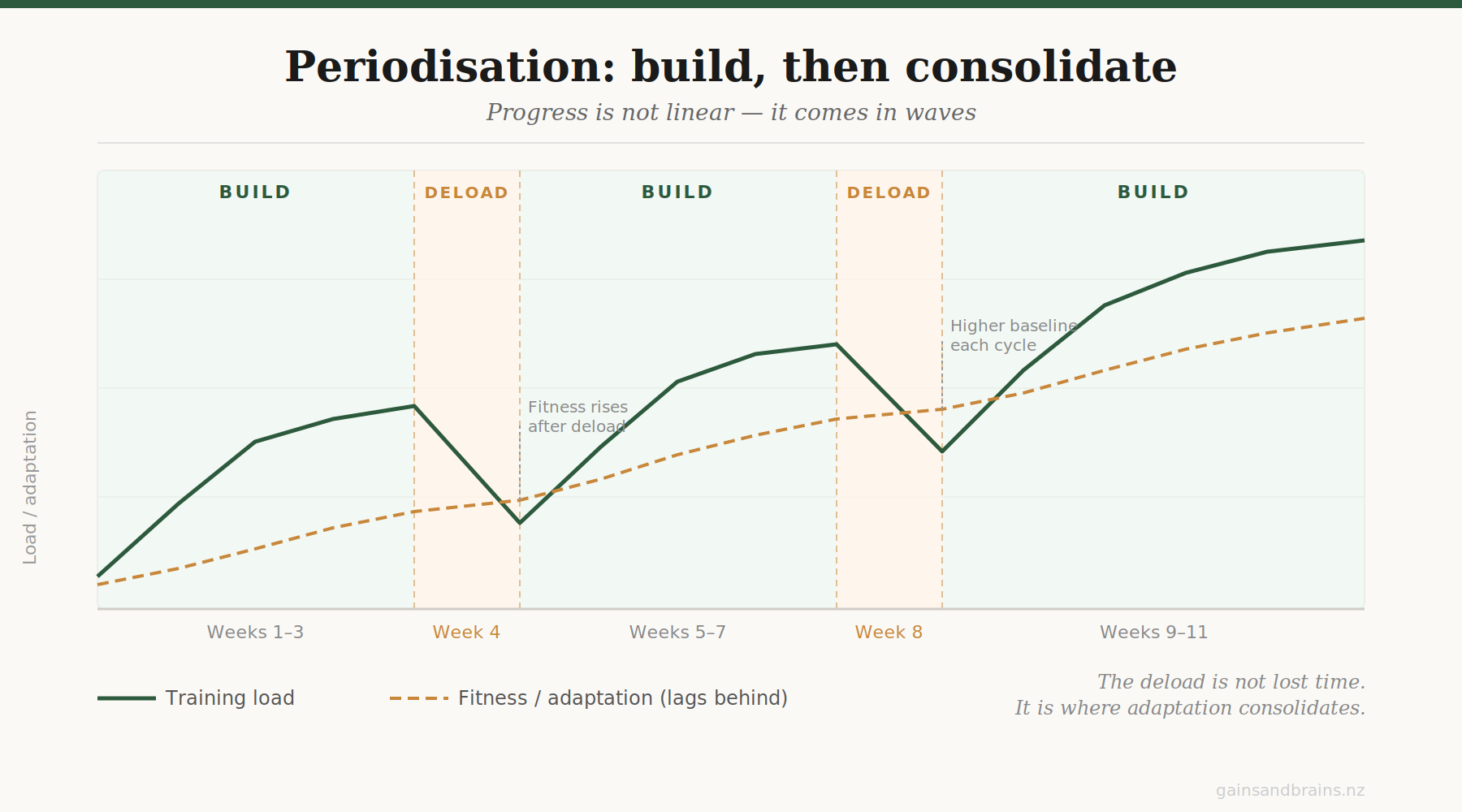
Consider periodisation. Rather than trying to progress every week, structure your training in blocks with planned variation in intensity and volume. A simple approach is three weeks of building followed by one week of reduced load to allow recovery before the next block. I refer to this as a deload week.
On Megan's notes app
80kg is a legitimate goal and I think it's fully possible, especially after witnessing your 60kgs with ease last week! I would be keen on diverting more resources to this goal now, especially given you are past the early recovery stages of your knee injury.
Progress will not always look like a new number on the barbell. Sometimes (and currently) it looks like better positions, cleaner technique, stronger accessories, and a body that is finally recovering well enough to respond. The 80kg is not a fantasy. It is just waiting on the right conditions.
Keep showing up. Stack the resources in its direction. The cogitation has already begun.