Pause, Poke, Squeeze, Step
One of the things I like to celebrate is what tiktok has taught me to call “non-scale victories.” These are ways to know that your body is changing in ways that have nothing to do with arbitrary “weight” or aesthetics.
For me, they’re often little things like “I carried the 40 KG bag of potting mix up the stairs easily” or “I danced for 30 minutes and my feet don’t hurt.”
There are all kinds of great things about exercise - clearer skin, better sleep, less pain - but the ones where you see how the work you’ve done translates into making life easier always feel more fun to me.
I’ve been trying to notice these as I have been rehabbing my torn meniscus, and recently, I had a fantastic one.
Over six weeks, I went to three Wellington Poua games (rise up Poua!) (yay women’s sport!!). We paid $59 for season tickets - all three games, snacks, and the joy of supporting badass women playing rugby. Cheap at twice the price.
At the first game, walking up the stairs into the stadium was a time. I was taking them one at a time, and I still felt pretty unsteady with all my weight on one leg. I remember being annoyed that visiting the merch tent was a trial.
Six weeks later, I bounded up the exact same flight of stairs, one foot on each step, without really even thinking about it. My knee could easily take it. It wasn’t until I sat down that I thought “hey, I couldn’t do that not that long ago.” And I could see exactly how far I had come in six weeks.
Recovery isn’t linear, we know that. As I write, my knee is more sore than it has been in weeks - probably because I’ve done more this week than I have in a while. And my progress at walking down stairs is definitely much, much slower.
One thing I think helped with the “up” version though, was slowing down. For about a week, every time I walked up stairs, I would plant my bung leg on the step, and think to myself “OK, I need to make my glute do the work here.” I would push my index finger into the meat of my butt, and actively squeeze the muscle.
Then, I would think about the position of my knee. Could I rotate it slightly so that my thighs were more switched on - in the way Riley has taught me and I have been using in my squat? And then instead of thinking about stepping up, I would push my foot down, pushing the ground (step) away.
I don’t know why I didn’t think about doing this before. I should know by now that what I learn under the barbell translates in spaces outside the gym.
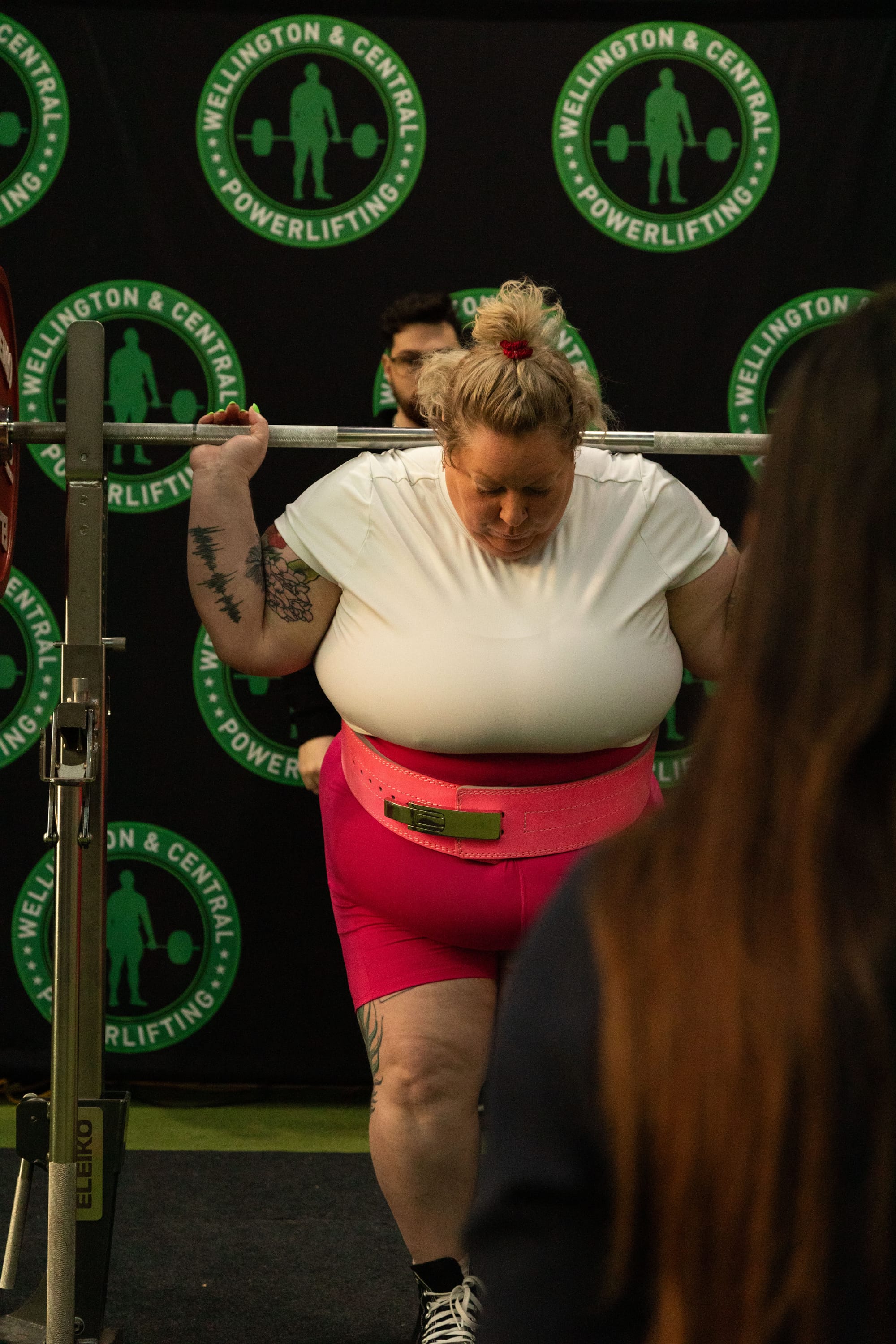
This is the same process as my big lifts, the same process of cueing to make my body do the things that are hard, and do them safely. This is how I make sense of muscles and joints and connective tissue working together.
Newbies often take time - understandably - to learn what “engage the [muscle]” means. It takes time to connect the nervous system together and make it make sense.
A few weeks on, I don’t have to follow this process anymore. I can just step up, even on days when my knee is playing up. I don’t have to tell my muscles what to do.
So now, I am going to experiment going down the stairs the same way. Pause, poke, squeeze, step. I reckon a bit of conscious thought now, will get me to unconsciously skipping down in no time.
I’ll report back.
Carl here…Megan's stair story gets at some of the biggest gains we get from the gym. Not the mirror or scales but for life.
I call these translatable gains. The moment when strength built under a barbell, in a squat rack, or on a gym floor, shows up somewhere completely unrelated, like carrying potting mix, dancing for half an hour, bounding up stadium stairs without a second thought. That's not a coincidence, It's your nervous system doing exactly what it's been preparing for.
Muscles don't have eyes
This is something I said this week and it stuck! Your muscles don't really "know" they're squatting, or step ups, or leg press. They know tension, sequencing, and load. Train a movement pattern well enough, in enough variations, and your nervous system builds a general purpose skill it can pull out wherever that pattern shows up again, including places you never trained on purpose.
This is why Megan's cue, thinking about her glute, rotating her knee slightly, pushing the step away rather than pulling herself up, worked so well. She wasn't inventing a new skill for stairs. She was borrowing a skill she'd already built at the gym and pointing it at a new challenge.
It also mattered that it mattered
There's a second reason Megan's rehab stuck the way it did, and it's not just about the movement pattern.
Neuroscientists Kleim and Jones, in a widely cited paper on how training actually reshapes the nervous system, laid out a set of principles for what makes practice translate into real neural change. One of them is salience. Basically, the training experience has to matter to the person doing it, not just get repeated by rote.
Megan wasn't grinding through generic physio homework. She was rehabbing so she could get up those stadium stairs and watch the Poua play. That's about as salient as it gets. Purpose attached to practice tends to build stronger, faster changes than mindless reps ever will, and I reckon that's part of why six weeks got her so far.
The three stages your brain moves through
There's a well established model in motor learning research (Fitts and Posner's stages of skill acquisition) that maps almost exactly onto what Megan described, so it's worth knowing the shape of it.
Cognitive stage. This is the "pause, poke, squeeze, step" phase. Everything is conscious and effortful. You're talking yourself through the movement one piece at a time, and it feels clunky because it is clunky. This is also exactly where beginners live when they're first learning to "engage" a muscle in the gym, and why that instruction can feel so abstract at first. You're not being uncoordinated, you're actually building the wiring.
Associative stage. The pieces start linking up. You need fewer verbal cues, fewer conscious checks, and the movement starts to feel like one thing instead of four separate instructions stitched together. Megan's "few weeks on, I don't have to follow this process anymore" line is a textbook description of arriving here.
Autonomous stage. The skill runs in the background. You can hold a conversation, carry a coffee, think about something else entirely, and your body just does the movement correctly. This is the goal, and it's also why well coached strength training keeps paying off years later in ways that have nothing to do with the gym.
About Cueing
We don't just cherry pick the research that fits the story round here. There's a separate, well established line of motor learning research (Gabriele Wulf's work on attentional focus, now spanning over fifteen years of studies) that generally finds people move better and learn faster when they focus on the effect of a movement rather than the muscle doing it. Focus on "push the step away" tends to beat focus on "squeeze your glute" once a skill is being refined.
So Megan's glute cue, an internal focus, isn't necessarily what you'd prescribe for peak performance in a fully healthy system. But early in rehab, after an injury, the feedback from that joint and those muscles is often genuinely patchy. In that window, internal cueing is doing double duty. It's not just coaching performance, it's helping rebuild the connection itself. Once that connection is back online, shifting the cue external, from "squeeze" to "push the ground away," would likely be the fastest route to full automaticity. (Automaticity is a real word, we promise!)
Why this all matters more than the scale
A non-scale victory like "the stairs didn't wreck me" isn't just a nice feeling. It's direct evidence that a skill has moved from the cognitive stage toward the autonomous one. That's measurable progress in the truest sense, even though no number on a scale will ever capture it.
It's also why we're fans of training with intent rather than just going through the motions. The specific cues Megan used (glute focus, knee rotation, pushing through the foot) aren't random gym jargon. They're the same cognitive tools that build any motor skill, whether that's a heavy lift or a rehab step. Learn to use them well in one context, and you've built a tool you can apply in many contexts.
So next time you notice a non-scale victory, it's worth asking what you actually did to earn it. Chances are it wasn't luck. It was weeks of conscious, clunky, deliberate practice, made stickier because it actually mattered to you, finally paying out as something that now just happens.