The Letdown
Back in my previous life, I once interviewed a doctor. I him "how come every time I go on holiday, I get sick?"
To paraphrase his answer: in the lead-up to a holiday, we're usually stressed - the planning, the packing, everything we're racing to finish before we leave. Cortisol and adrenaline are quietly propping up our immune system the whole time. Then we relax, and the props fall over. (It’s called the letdown effect.)
For the past month, everyone in my life - the people I share houses and beds and cars with - has been coming down with the same cold. A nasty one, with a wheezy cough, several days of malaise, and enough snot to sink a small dinghy.
I managed to not get sick, and I was pretty smug about my immune system. And then, lo and behold, this week, I finally caught it. Turns out my endocrine system was just letting me get through some pretty major life stuff - and the Gains and Brains podcast debut - before it collapsed.
Thanks, immune system.
What it didn't do, this time, was send me into a spiral. When I was first on this whole fitness journey, I was hypervigilant - every twinge, every cold, felt like it might be the thing that finally made me quit lifting for good.
I've made my way back every time, and along the way I've learned the lesson of not going back too fast. In the Covid times, the gym gave us return-to-training guidelines: start light, build volume slowly over a week or three before touching your old numbers again. Sensible. I promptly ignored it.
I remember finishing a session after Covid, annoyed I couldn't lift much, wondering why I was so tired. I tried to push through anyway. That decision cost me months.
There's a time for pushing through, but it's not when you're sick, and it's not when you're recovering. Those are times for rest, carbs, and gentle movement. When you're surrounded by used tissues, half-drunk cups of lemon and honey, and the TV remote, the weights can wait.
I'm on the improve. I've been away from the gym for 10 days, between life and this cold. It will still be there when I'm well. And I'll be stronger for waiting until I am.
So, Carl - how do I come back safely now? While I assume I have a few weeks of coughing up post-viral phlegm ahead of me…
Carl here…
Megan, welcome back to the land of the living. And credit where it is due, because the version of you from a few years ago would have been under a barbell on day three. This is such an important thing to understand as an athlete/gym bro and something to be taken seriously. Covid made me aware of this as I was responsible for creating our return from COVID protocol, guided by science.
Your doctor's answer holds up better than most things people repeat about immunity. Cortisol and catecholamines do shift immune function around while stress is sustained, and the picture changes again when arousal drops away quickly. The caveat I would add is about the strength of the evidence rather than the idea itself. The cleanest study on the letdown effect followed migraine sufferers through a three month daily diary and found that the *level* of stress did not predict attacks, but a decline in perceived stress from one evening to the next raised the odds of a migraine over the following six to eighteen hours by roughly 1.5 to 1.9 times (Lipton et al, 2014). That is a genuine signal in one condition. For colds it is mostly observational and mechanistic reasoning. So: plausible, probably real, not yet nailed down. Which is a comfortable place for us to sit.
Now to your actual question.
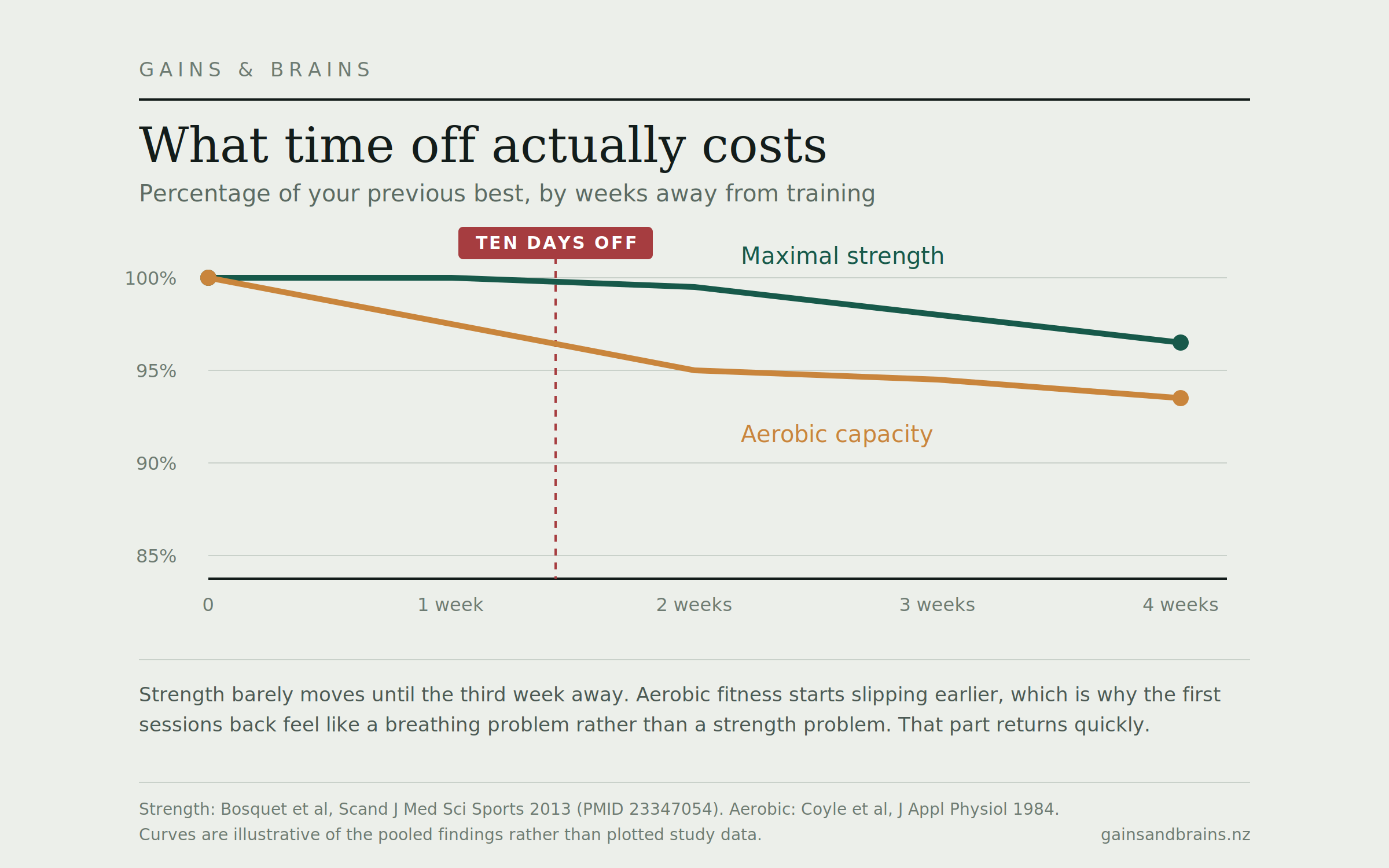
Ten days off has cost you almost nothing
The largest pooled analysis of training cessation drew on 103 studies and found that the drop in maximal force does not become statistically meaningful until around the third week of inactivity, with trained people holding on better than untrained people ([Bosquet et al, 2013). Cardiorespiratory fitness fades faster than strength does, so your first sessions back will probably feel like a conditioning problem rather than a strength problem. You will be puffing on sets that never used to make you puff. That is not lost strength. It is a different system, and it rebuilds fast.
Before the first session
Two entry questions, borrowed from the graduated return protocols that came out of the COVID years:
1. Can you get through a normal day, including stairs and walking on the flat, without unusual fatigue or breathlessness?
2. Is your sleep and appetite roughly back?
If yes to both, you are ready to start. If no, you are still resting. Any fever, a resting heart rate sitting well above your normal, or night sweats mean wait.
The first three weeks back looks like this:
Work in steps of about 48 hours and let the following morning be your judge.
Days one and two. Walking, easy bike, mobility. Conversational effort only.
Days three and four. One full body session. Around half your usual number of sets, loads near 60 percent of what you would normally use, every set finishing four or five reps shy of failure. Perceived exertion around five or six out of ten.
Days five to eight. Normal session structure, volume climbing back toward usual, loads still short of your best numbers.
Weeks two and three. Reintroduce heavy singles, sets taken close to failure, and anything that historically leaves you flat the next day.
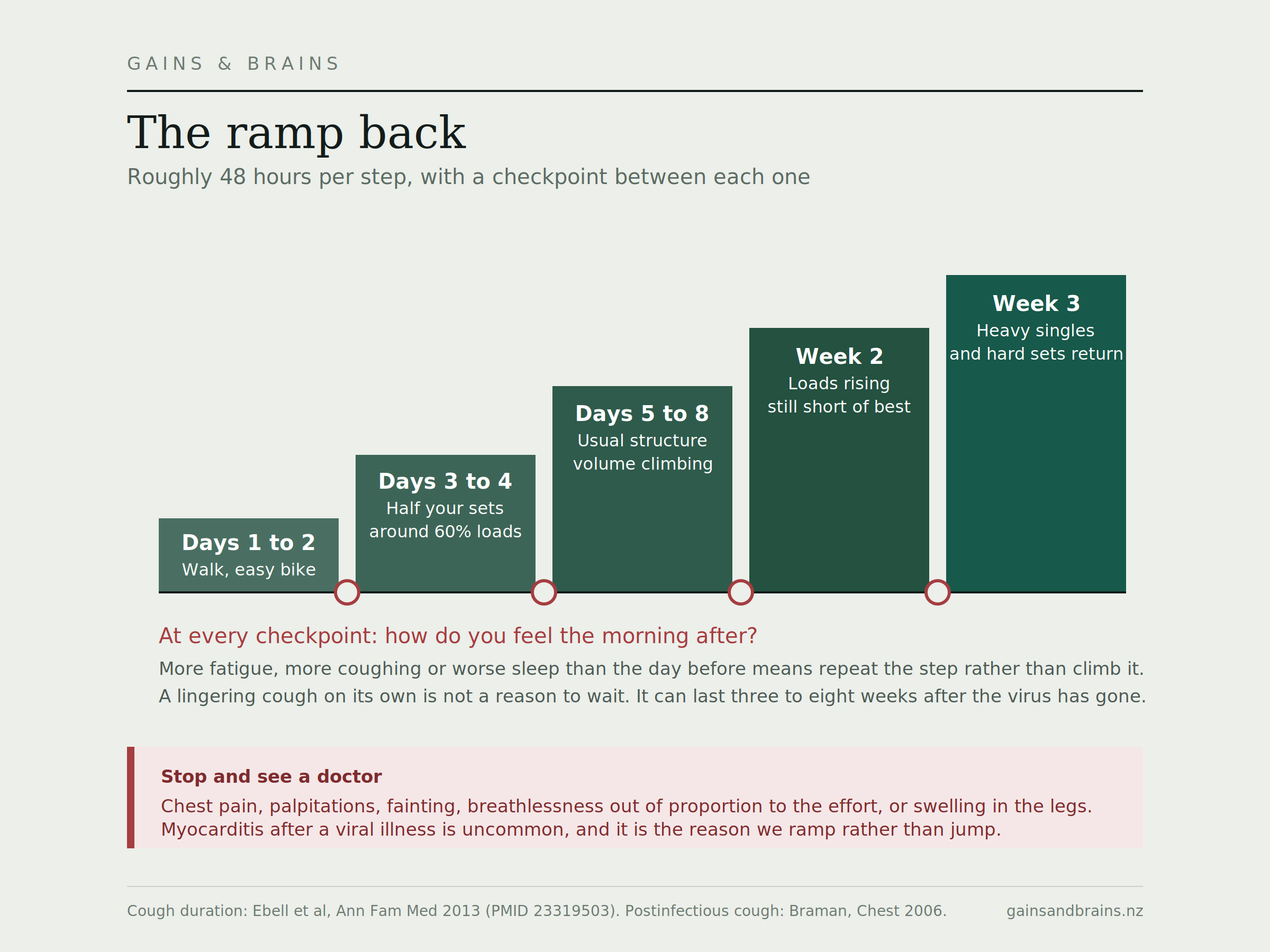
The rule that matters more than any of the numbers: if the morning after a session brings more fatigue, more coughing, or worse sleep than the morning before, repeat the previous step instead of progressing. The 10 percent weekly increase you often hear quoted is a rule of thumb rather than a law, but as a ceiling for these three weeks it is sensible. Keep protein and total energy up while you are doing less, because that is what protects tissue when the training stimulus is small.
About the phlegm forecast
You are probably right, and it is not a reason to stay out of the gym. Acute cough after a respiratory infection runs a mean of about 17.8 days in the published literature, while most people expect it gone inside a week (Ebell et al, 2013). Past three weeks it earns the name postinfectious cough and can persist for up to eight. By that stage the virus is long gone. What remains is an inflamed, twitchy airway healing at its own pace.
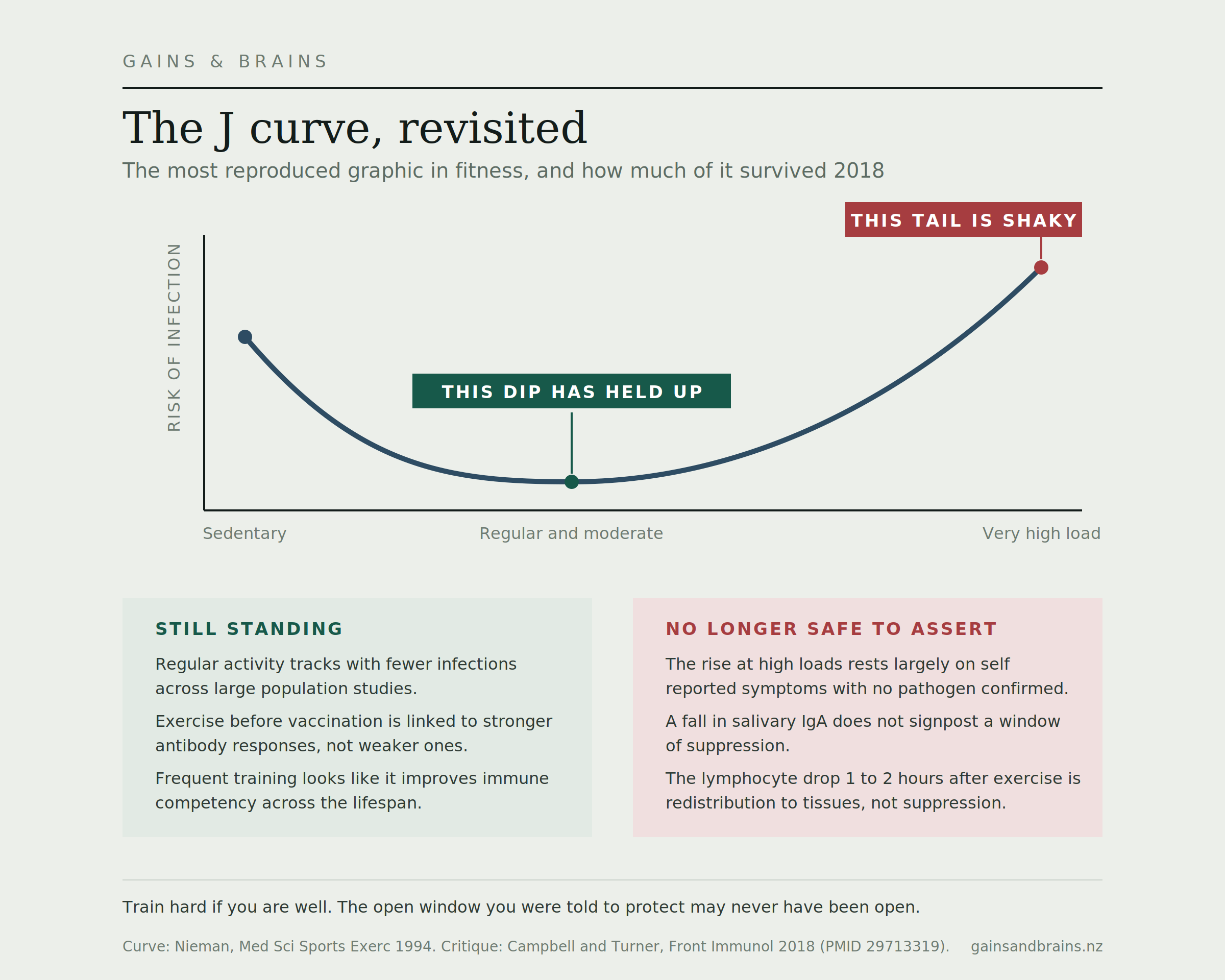
So do not use the cough as your readiness gauge. Use energy, sleep, appetite, and how you feel the morning after training. A cough that is stable or improving is background noise. A cough that is getting worse is information.
The reason we bother being careful
Chest pain, palpitations, fainting, breathlessness out of proportion to the effort, or swelling in the legs. Any of those and you stop and see a doctor rather than pushing through. Myocarditis after a viral illness is uncommon, and most cases resolve fully with rest, but it is the one complication worth building a permanent habit around.
The part you already got right
The thing I most want to draw out is not the programming. It is that you did not spiral.
The fear avoidance model describes the loop well. A threatening reading of a symptom leads to avoidance, avoidance leads to deconditioning and lower confidence, and lower confidence makes the next symptom feel more threatening still. Ten days off with a plan is not that loop. Ten days off spent auditing every twinge and quietly wondering whether this is the one that ends it, that is the loop.
After COVID you were annoyed and you pushed. This time you were annoyed and you rested. Those look like the same situation with a different outcome, but they are not. They are different skills, and the second one guided by wisdom and experience.
Start light, judge by the morning after, don’t take the phlegm too seriously and watch your chest. You will be back on your numbers inside three weeks and the bar will not have noticed you were gone.