
Inner Voices
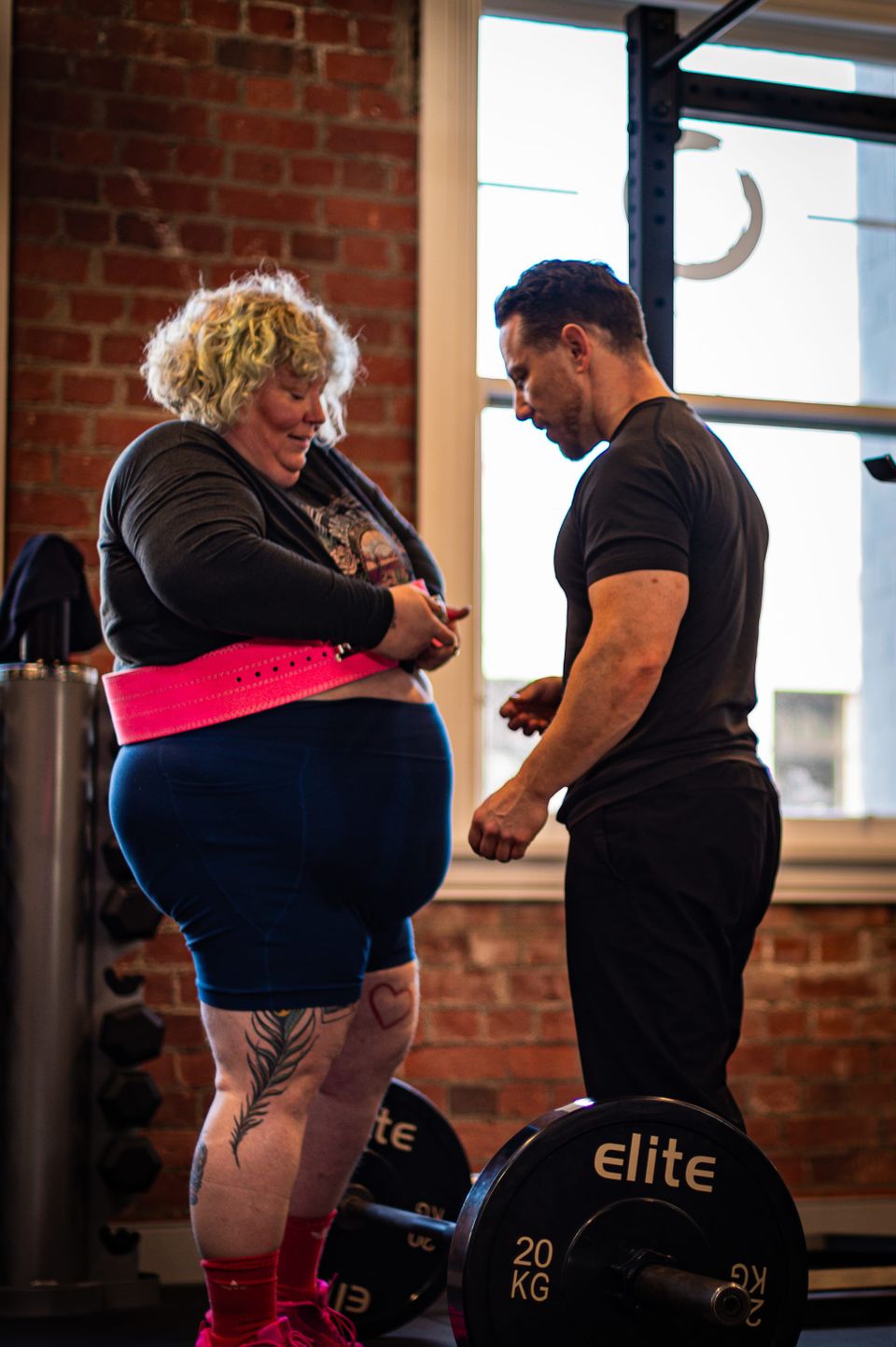
Happy weekend, friends! Megan here.
I have been laid up this past couple of weeks - a cold that turned into bronchitis, complete with lungs that sound like a popcorn maker when I am lying down.
I am following doctor's orders and avoiding the gym until I can walk up a flight of stairs without a two-minute coughing fit. Such growth!
Man, I miss it though. I miss how capable the gym makes me feel. I miss the good endorphins, I miss the tiredness after a good session. I miss the sound of two heavy plates smacking together as I load a bar. I even miss Carl and the sessions where he decides to make me be sore for three business days.
You've probably clocked that this feeling isn't just from the bronchitis. This is the past 12 months of battling, then rehabbing an injury, and the lingering feeling that even though I am demonstrably getting better, I might never actually be better.
I was chatting to a friend this week who recently had surgery. She's back moving, but said she's scared to lift heavy. Even though she's been cleared by her medical team, every time she thinks about squatting with weight, her brain rebels, convinced her long-healed stitches might somehow pop.
I feel this when squatting. Even though I know my knee can handle it, there is a voice in my head that is concerned that if I squat too deep, there's no way I am getting back up, and that the healing tissue in my knee will tear like wet tissue paper. And so, I have been - deliberately or not - avoiding flexion.
Walking down stairs is the same, and is also my bugbear. I know I can do it, and I do it properly, like 40% of the time. But the rest of the time, the little voice in my head reminds me that putting all my weight on my knee hurts (even though it doesn't really), and that if I do it wrong, my knee will collapse in on itself and I will tumble the rest of the way down the stairs.
And don't even get me started on kneeling.
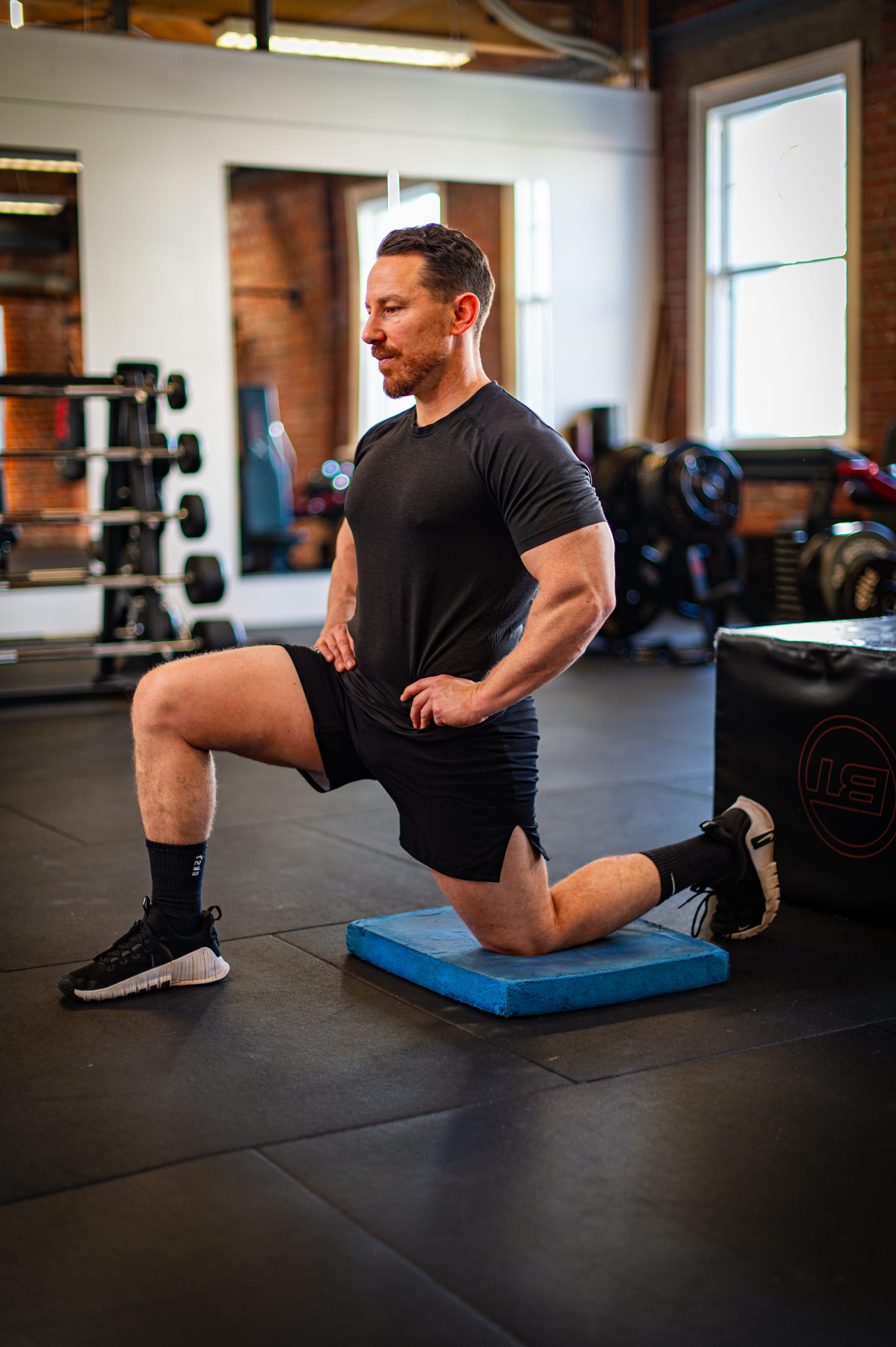
My physio, Riley, actually has me doing exercises to solve these exact problems - some plyos assisted by bands, and deep lunges, also assisted by bands, and a soft surface.
Old Megan (pre-gym Megan, who would happily have worked a 40-hour week with lungs that sounded like a dog crunching biscuits) would have said: get over yourself, and just do it. Why are you letting that voice win?
But I know better now. I know the answer isn't to shut up the cautious voice - because she's the reason I didn't tumble down the stairs in the past six months. She kept me safe. She just hasn't caught up with where my knee is now.
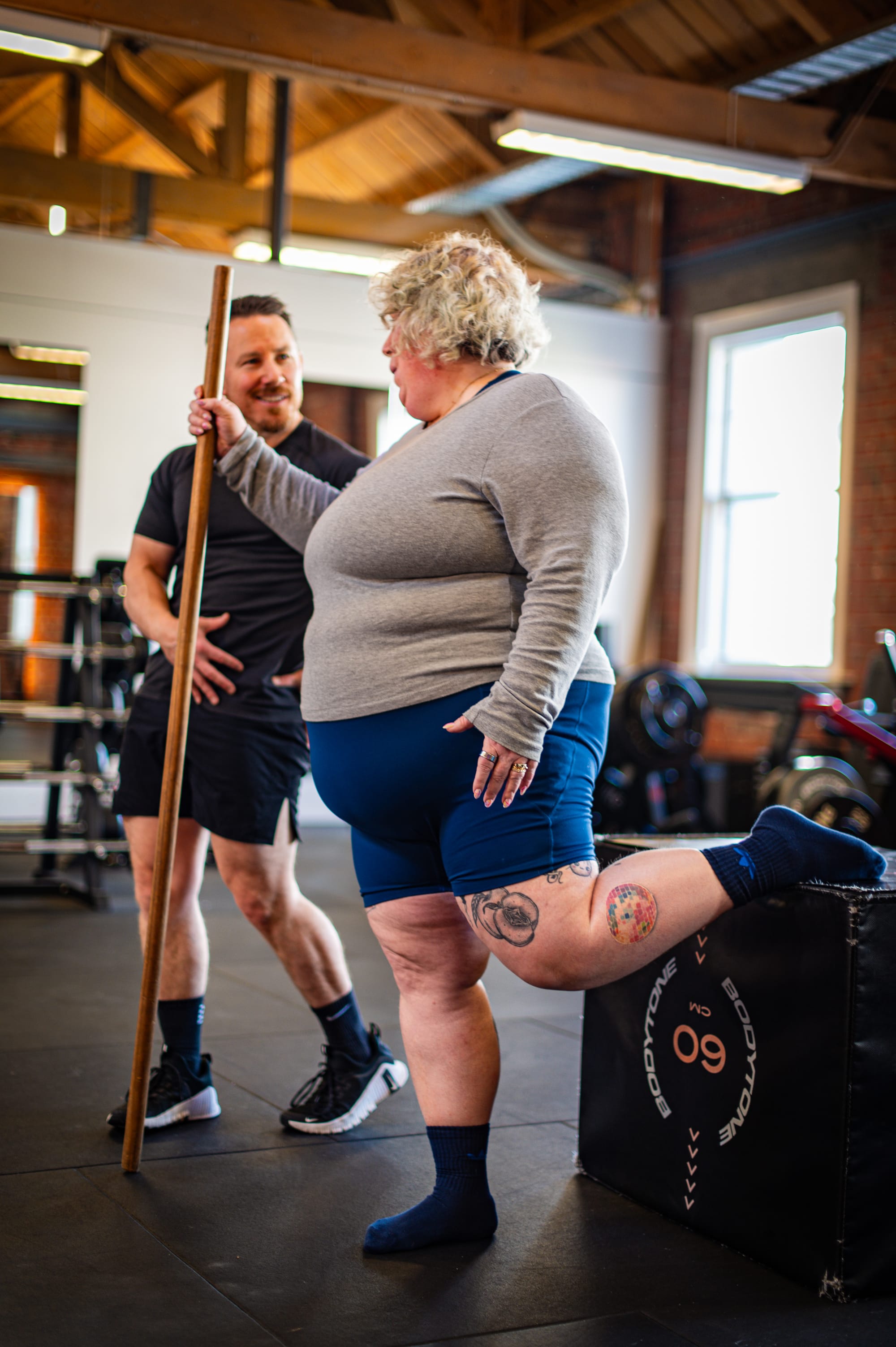
The answer is, like many things, graded exposure. It's learning to kneel on a mattress, then a box, then a thick pad, then a folded blanket, then a plush rug, then the floor.
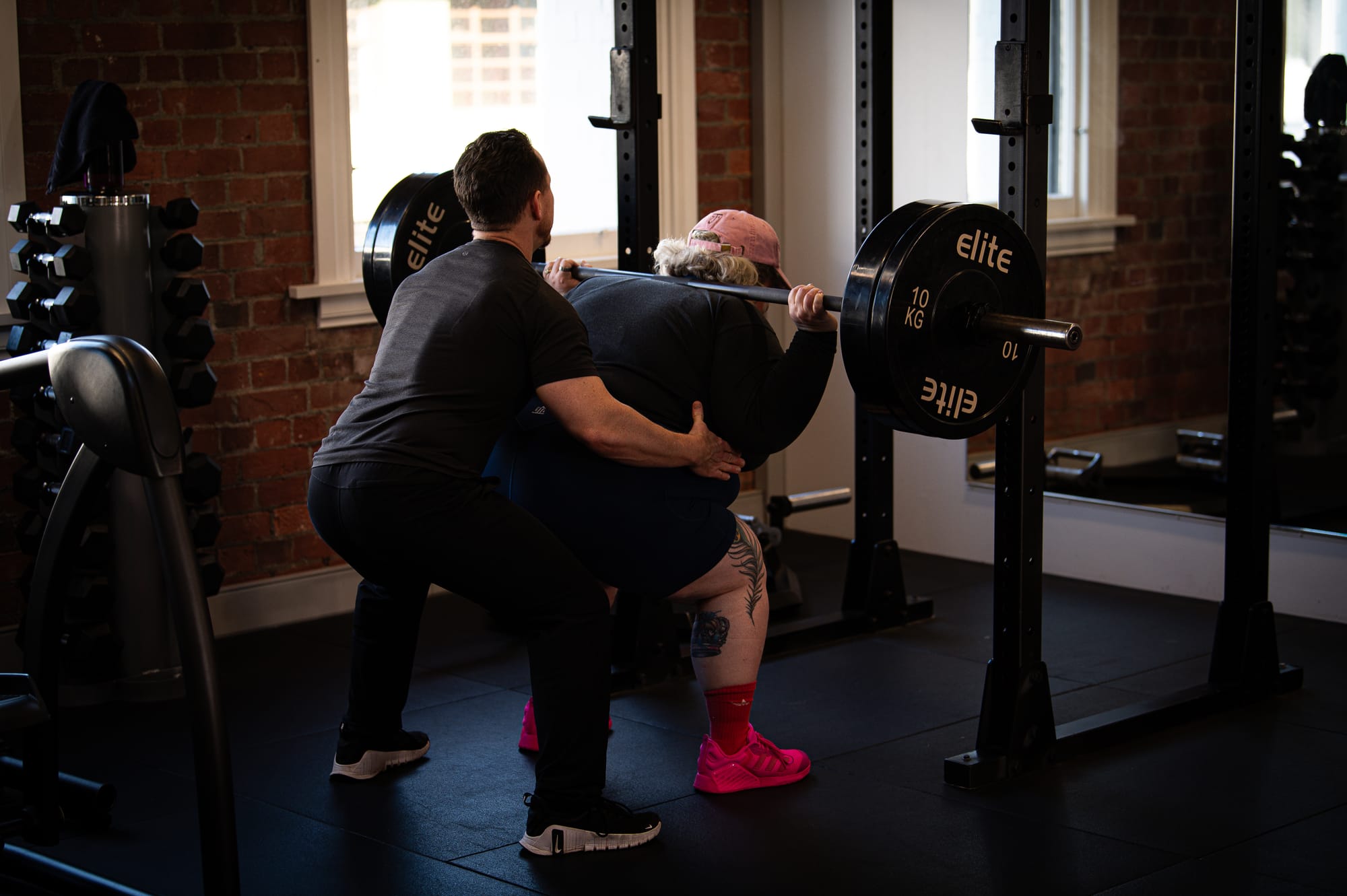
It's assessing my squat depth, and then working to increase it, and laying off the ego lifts until I know I can get back up.
It is the boring stuff of progressive overload, and all the training I've done for the past six years.
Right, Carl?
Carl here...
Totally, Megan. Though I'd argue it isn't just progressive overload for your knee, it's progressive overload for your brain. (And for the record, three business days of soreness is a sign of respect. You're welcome.)
This one is personal for me too. During my ACL reconstruction rehab, my physio asked me to sink into a deep squat. Before I'd even moved, my brain announced "that's going to hurt," and my internal dialogue added, "are you fkng kidding me?!" Then I did it completely pain free. That gap between what my brain predicted and what actually happened made me really curious, and it turns out it's exactly where the science gets interesting.
What Megan is describing is incredibly common. Her friend who's scared her stitches will pop, Megan bracing on every stair, the lifter who's been cleared but won't go below parallel. They are different stories but the same mechanism. So let's look at what's actually going on, and how to make graded exposure work as well as it possibly can.
The science
The cautious voice is a smoke alarm
Megan is spot on that the cautious voice isn't the enemy. Injury is a powerful teacher as your brain links a movement with a threat and sets an alarm on it. Pain researchers describe this as fear learned through association, which then drives protective, avoidant behaviour (Vlaeyen & Linton, 2012).
That alarm was super useful early on. The catch is that a learned alarm doesn't always switch itself off when the tissue heals or the pain fades. It's a smoke alarm that still screams at burnt toast long after the kitchen fire was put out. That's why "it doesn't really hurt" doesn't settle anything. Your brain isn't asking "will this hurt?" It's asking "will my knee collapse on this stair?"
The body updated, the brain didn't
Think of your phone, your knee has installed the latest software update, but your brain is still running last year's version.
We see this clearly in the research on people returning to sport after ACL reconstruction. In a large meta-analysis, 81% got back to some sport, but only 65% returned to the level they played before, and lower fear of reinjury favoured a successful return (Ardern et al., 2014). Across a wider range of injuries, motivation, confidence and low fear were linked with getting back to previous levels and getting there faster (Ardern et al., 2013).
Most of this research is on athletes. But you don't need a jersey for it to apply. The same lag shows up on stairs, kneeling to garden, getting down on the floor with your kids, or lifting a suitcase into the car.
You can't update an app you never open
Avoidance feels safe, and often we don't even notice we're doing it. Megan avoiding flexion "deliberately or not" is a perfect example. But every time we skip, soften or shortcut the scary movement, the brain misses its chance to learn something new. Avoidance is one of the main ways fear keeps itself going (Leeuw et al., 2007). Time alone doesn't fix it, because time doesn't give the brain fresh evidence.
Surprise is the software update
This is why graded exposure works. Fear shifts most when what happens is clearly better than what you predicted. The bigger the gap between "I'll tumble down the stairs" and "that was fine," the more the brain learns (Craske et al., 2014). The same work suggests the learning sticks better when you practise in varied settings and gradually drop the safety behaviours that make you feel protected.
And doing beats being told. Confidence, or self efficacy, grows most strongly from your own mastery experiences and doing the hard thing yourself and seeing it go fine (Bandura, 1977). You basically have to collect the evidence for your brain and body.
The Goldilocks rule
Megan's line about laying off the ego lifts is backed by some genuinely interesting research. You'd assume more confidence is always better….
- Too little: in younger patients (20 and under), lower psychological readiness was linked to a higher risk of a second ACL injury after returning to sport (McPherson et al., 2019).
- Too much, too early: patients with high readiness just three months after surgery had more second ACL injuries over the following two years (Ueda et al., 2024). In a small study of female athletes, those who went on to reinjure had the most positive outlook and met return to sport criteria sooner (Zarzycki et al., 2024).
These are associations from small samples, not proof of cause. But the message is useful. We're not trying to bulldoze the cautious voice or drown it out with bravado. We want confidence that's earned, one rep at a time, by what your body can actually do. Like Goldilocks, not too hot, not too cold, just right. A physio is great for guiding this process as they have very smart protocols and assessment systems to get it right (it also takes it off your plate and out of your head too).
Making graded exposure work harder (if you don't have a physio to guide this).
Megan's kneeling ladder (mattress, box, pad, blanket, rug, floor) is a great model. Here's how I'd build on it, whatever your injury and whatever your goal.
1. Find where the fear actually lives. It's often more specific than "my knee." It might be depth, speed, going down rather than up, being tired, carrying something, or being on one leg. Rate your confidence out of 100 for each task. The lowest scores are where to start working.
2. Build a ladder for each one. Keep the movement, scale the threat. For stairs, that might look like a low step with two hands on the rail, then one hand, then a fingertip, then no hands, then a normal step, then normal pace, then carrying a bag. Climb one rung at a time, and stay on a rung until it feels boring.
3. Predict, then test. Before you try, say what you think will happen: "My knee will give way on the third step." Then do it. Then ask, "Did that happen?" That gap is where the learning lives, so make it obvious and say it out loud, as your brain likes the receipt.
4. Check for the hidden handbrake. Fear changes how we move, often without us noticing. Leading with the good leg every time, gripping the rail, shortening range, shifting weight away from the injured side. It's like driving with the handbrake half on. Ask a friend or coach to film you from the front, or watch yourself in a mirror. Seeing it is often the first step to letting it go.
5. Take the training wheels off slowly. Bands, soft surfaces, a knee sleeve "just in case," always using the same rail. These are brilliant early tools, and Riley's banded plyos are exactly that. The goal is to fade them, one at a time, so your brain learns "I was fine without it."
6. Add a bit of variety. Different stairs, different surfaces, different times of day, a little tired, a little rushed. Life isn't scripted, so your brain needs to learn "safe" in lots of places, not just the physio clinic.
7. Mind your self-talk. "Be careful" and "don't stuff it up" keep the alarm volume high. Try "my knee has done this hundreds of times" or "let's see what actually happens." You're pointing your brain at the evidence.
8. Keep a wins log. Write down every feared task you complete, not just the kilos you lift. Megan's 40% on the stairs isn't a failure stat. It's a baseline, and the log is how you'll watch it climb.
On feeling like you'll never actually be better
This might be the most important bit. Megan described feeling like she's "demonstrably getting better" but might never actually be better. If you've been through a long injury, you probably know that feeling.
Recovery is rarely a straight line. Good weeks, bad weeks, a cold that turns into bronchitis and knocks you back. On any single day it can feel like nothing's moving. That's exactly why the wins log matters as it shows you the trend that your worries won't. Progress you can see is a powerful antidote to fear that tells you otherwise.
One Caveat
Graded exposure works best when your tissue is genuinely ready, so this sits alongside your physio or medical team's guidance, not instead of it. New pain, swelling, or something giving way means checking back in with them. And if the fear feels big or just isn't shifting, a psychologist who works with injury is well worth it. There's no prize for doing this the hard way.
Your body healed on its own timeline and our brain deserves its own rehab respect too. The cautious voice kept you safe, now it's time to give her some new information and evidence. Thank her, then show her, one rep at a time.