What Your Body Can Do
Buckle in, whānau. This is a long one - but there’s an exciting thing about halfway down!
I (Megan here!) moved house this week. While we got movers, I have still done a lot of lifting, moving, crawling and holding solid planks of wood while my boyfriend screwed them into the bookshelf.
One of the things that is fun about being a lifter is knowing that that 40kg box full of books is just a light deadlift by my standards. Even though it’s unwieldy, it’s not actually beyond my capacity.
(Shoutout to the movers tho, who were carrying 2-3 of said boxes at a time, and up and down multiple flights of stairs. I could never.)
Whether it’s your weekly grocery shop, a bag of potting mix, the squirming toddler at your hip, or the friend who is paying you in pizza to move their couch, it is nice to know that you are strong enough to handle what life throws at you.
I have been thinking a lot about being strong of late, and not just because of the 50 moving crates we’ve schlepped from one room to another.
People have called me strong all my life. A “strong personality.” Someone with “strong opinions.” I am brave for wearing sequins and I am resilient as all hell. Like most women, I have had to be. I never earned being “strong”. It was thrust upon me by life and bad boyfriends and awful bosses.
In the pictures Mel took of Carl and I there’s one of my bicep in a shoulder raise. I have been marvelling over that picture, because it’s the first time you can really see the bulge of my bicep in a way that made me feel properly jacked.
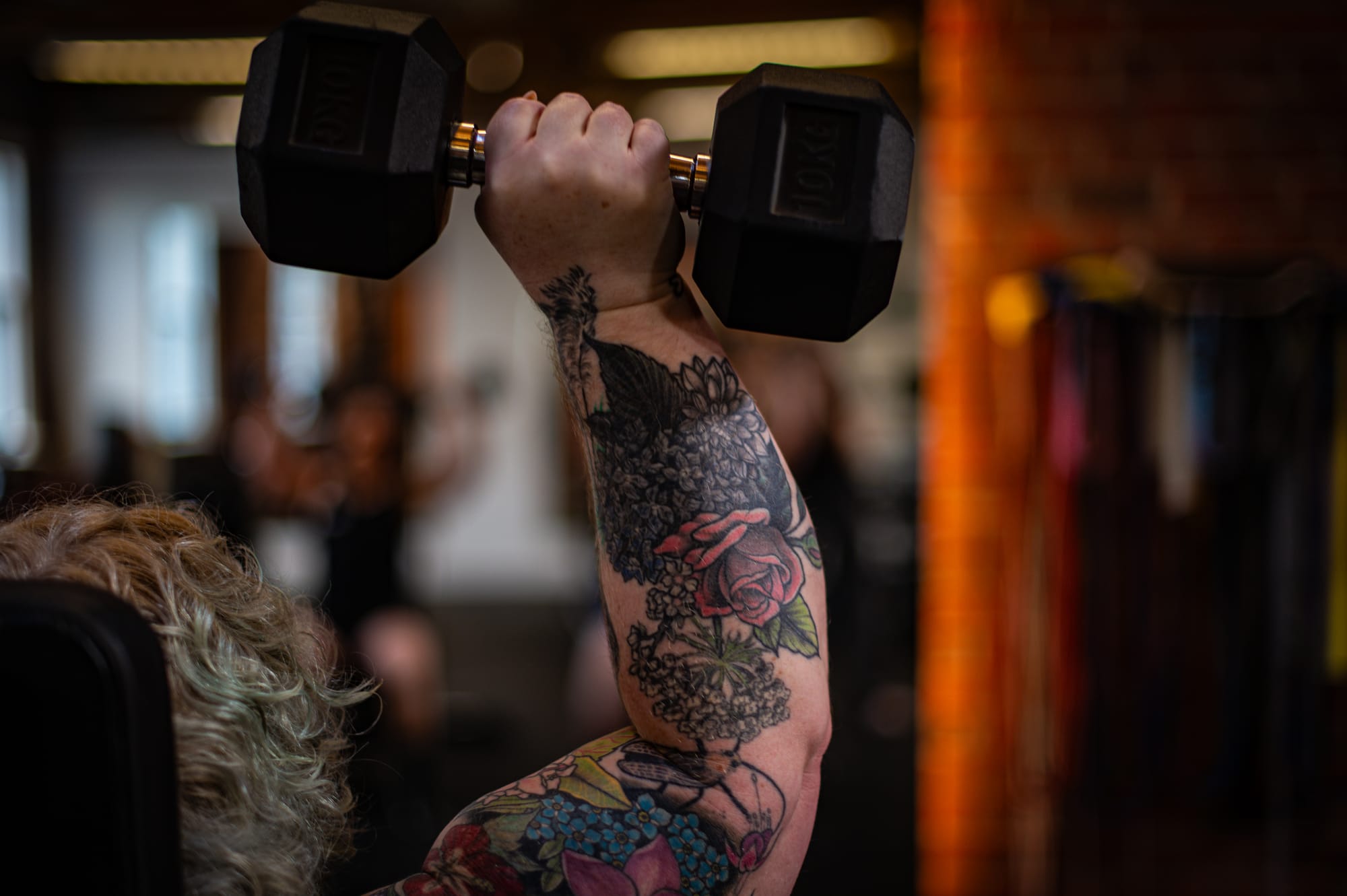
(It’s never about aesthetics, etc etc, but it’s pretty reasonable to want your outsides and insides to align, and it’s exciting to see muscles where there weren’t muscles before.)
While I have felt emotionally strong for a while now - or at least, I recognised I had the capacity to be, even if I wasn’t feeling it - it’s only the past few years I have felt my muscles start to match that internal strength. And unlike the resilience, I chose it, and I worked really hard to get it.
And now I am hooked on it. Even when my body feels like someone hit it with a moving truck, I can’’t imagine going back.
This is why I encourage more women to lift. Not just because we’re living through a skinnypocalypse fueled by weight loss drugs and conservative politics (as we discussed last week) but because I know so many strong, incredible women who spend so much more of their time thinking about how their body looks to others than what it can do.
I can’t imagine living another day where I worried about whether my ass looked fat in jeans more than whether my glutes were firing in a Bulgarian split squat. Or whether I had “earned” my food rather than seeing it as both necessary for life and also fuel for my muscles.
For me, that change was revelatory, freeing and the most empowering thing I have ever done in my life. I’ve said it before, and I will say it again to anyone who will listen: strong women are the best.
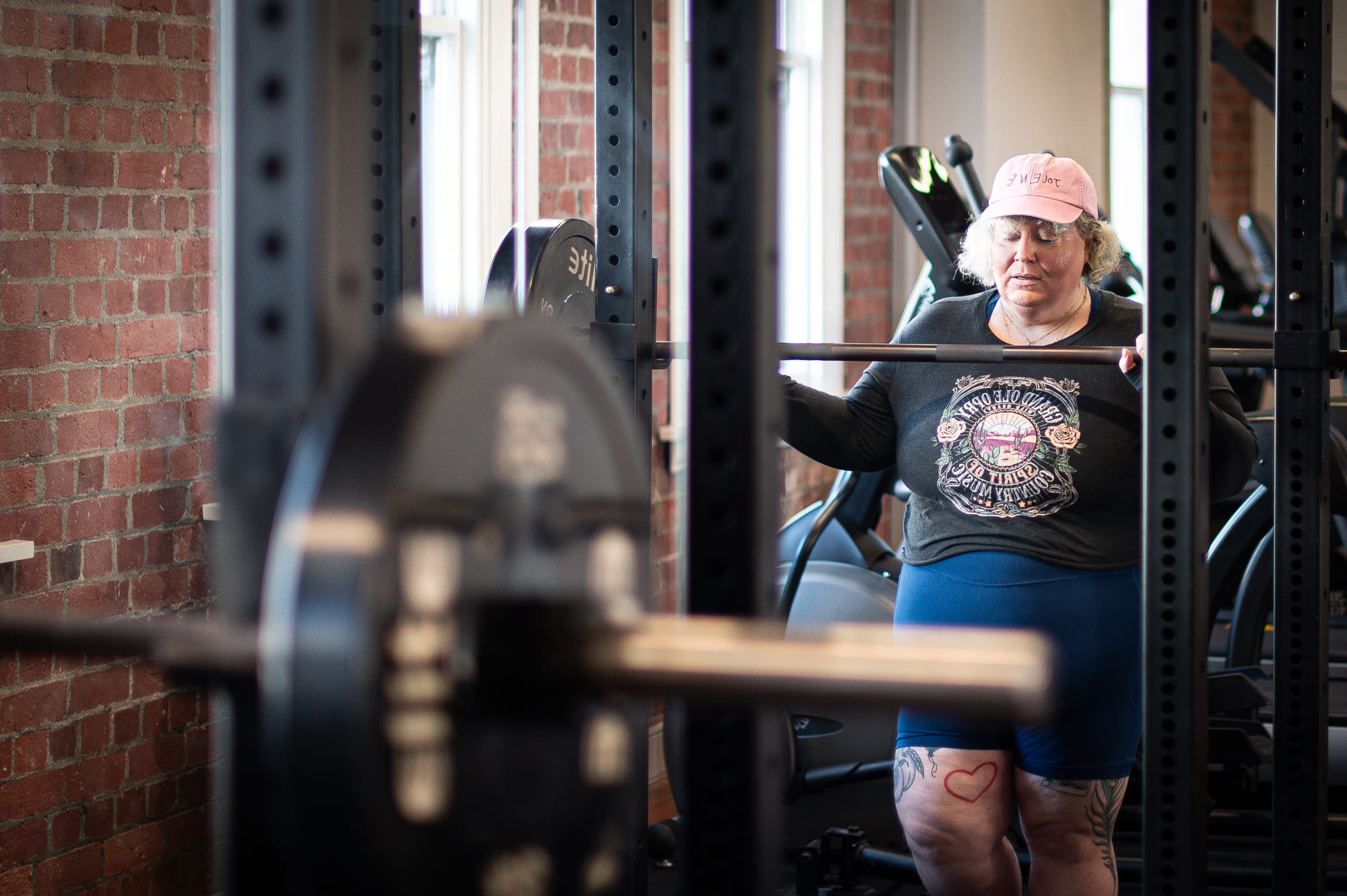
To quote the brilliant Irish Comedian Kyla Cobbler fuck getting skinny, we’re getting “furious and jacked.”
We’re growing our traps and exercising our pelvic floor. We’re looking after our bone density and our muscle mass. We’re keeping our joints strong. We’re maximising our grip strength and making sure we can stand up when we’re old ladies so we never have to ask a man to put our bags in the overhead bin on a plane.
Carl and I are keen to help more women on that journey. If you’re here, you’re already on that journey with us. And remember, strength is something we can measure, and heavy is what feels heavy to you. Getting physically strong made me so much more emotionally and mentally fit than all those bad boyfriends and incompetent bosses ever did.
So, we’re doing a thing…
We’re going to hold a women’s lifting competition. Gains and Brains x Healthfit, time and place TBD. We’ll do the big lifts - squat bench deadlift - but some extras as well, just for fun. We are very much still ironing out the details, but we want to give our (Wellington-based and anyone who wants to travel) a chance to strut their stuff in a room full of bad ass women who want to get stronger. Without the pressure of a full on competition, but definitely with some friendly smack talk (that will probably just be me and Carl at each other.)
We’re thinking some time in December. You in?
As always, Carl brings receipts
Carl here…
I think this is one of the topics Megan and I are most passionate about. You probably all know this already but, I am a father of two daughters and gym studio owner, which means I spend a lot of time thinking about what I want them to hear about their bodies before the world gets to them first (in my oldest’s case, to help combat what she already sees in the world).
There is still a lot of messaging that is not accurate, and not helpful. Women often still tell me they want to get "toned" and men will tell me they want to get "big." Same adaptation, same barbell, completely different language, and the language isn't neutral.
That language comes loaded with decades of messaging that a strong woman is somehow a problem to be managed rather than an outcome to aim for. Pilates reformer classes get sold as sculpting and for women. Squat racks get sold as bulking for the big guys. It's the same resistance training principle wearing two different outfits, and only one of them is allowed to be about getting strong.
The worry is apparently that lifting heavy will make a woman "too big." Megan and I often joke about this and laugh as we say "let's cross that bridge if we get to it. Because it's so hard to do (for anyone!).
Adult men carry roughly ten times the circulating testosterone that women do, and that difference is the main reason men hold more absolute muscle on average. But a Bayesian meta-analysis published last year, pooling 29 studies, found that when you look at muscle growth relative to where someone started, the response is essentially the same in women as in men. Women aren't running a lesser version of the program. The capacity to get strong and build muscle is right there. What isn't there is the hormonal profile to accidentally end up looking like a bodybuilder. That physique takes years of deliberate, specific training on top of adequate nutrition and recovery strategies!
And the payoff for training is something far more useful than an aesthetic. Grip strength alone, one of the simplest things we can measure, is among the strongest predictors we have of how long someone lives. A meta-analysis pooling more than three million people found grip strength independently predicted all-cause mortality, with the highest-risk group carrying more than double the mortality risk of the strongest.
And, a study published in JAMA Network Open in February this year that followed more than 5,000 women aged 63 to 99 and found that for every seven kilograms of grip strength, mortality risk over the following eight years dropped by around twelve percent, even after accounting for how active or sedentary the women were.
Grip strength almost certainly isn't magic in its own right. It gets measured so often because it's quick, cheap and safe to test, and because it stands in nicely for your whole-body strength and muscle mass. So it's a window on how strong you are overall, and overall strength is the thing worth building.
For women there's a specific and time-sensitive version of this, and it's the one I most wish got talked about before it's urgent rather than after. Around menopause, the drop in oestrogen accelerates the loss of both muscle and bone. Muscle loss with age has a name, sarcopenia, and women hit it faster through the menopausal transition, alongside a faster decline in bone mineral density than men of the same age. That's the bad news. The good news is that lifting is one of the few things that pushes back on both at once. This is something Megan and I talk about a lot - lifting for our old bodies.
A 2025 meta-analysis of 17 randomised controlled trials found resistance training significantly improved bone density at the spine and hip in postmenopausal women. And the LIFTMOR trial, a randomised controlled trial in postmenopausal women who already had low bone mass, found that heavy resistance and impact training improved spine bone density and was safe and well tolerated, directly overturning the old and still widely repeated idea that women with fragile bones shouldn't lift anything heavy. For a lot of women that advice runs exactly backwards. The barbell isn't the risk. Reaching your seventies without ever having built the muscle and bone to protect yourself is the risk.
Then there's the part Megan writes about, the inside catching up with the outside. This isn't just a cool line. A systematic review and meta-analysis of 29 randomised controlled trials, in people with clinically diagnosed depression, found that resistance training produced a large reduction in depressive symptoms compared to those who didn't train, an effect that held whether the depression was the main issue or came alongside something else. And it isn't only true in the general population.
A randomised controlled trial of older women specifically, published in Aging and Mental Health, put a group through twelve weeks of supervised progressive resistance training and found reductions in both depressive and anxiety symptoms compared to a control group who didn't train. The strength you build under the bar genuinely seems to travel with you out of the gym. I have watched it happen to people I coach, over and over. The barbell teaches you that hard things can be trained for and gradually met, and that lesson does not stay in the gym.
What the strongest evidence actually points to is self-efficacy, the belief that you can act to affect your own circumstances. A sixteen-week barbell training program, in a group that was more than eighty percent women, found that as people got stronger their self-efficacy rose alongside it, including their confidence that they could handle the training and recover from setbacks. As we’ve talked about before, self-efficacy is one of the better-established ingredients of psychological resilience, and because women are the group usually left out of this research entirely.
(I'll be straight about the limits: that study had no control group, so it shows an association rather than proof, and the direct trial evidence that lifting raises resilience scores specifically is still thin. I won't overclaim it. But the through-line is reasonable and it matches what Megan describes: you load a bar you weren't sure you could move, you move it, and the proof that you are more capable than you thought is now sitting in your own hands. Repeat that a few hundred times and it starts to feel less like a story you tell yourself and more like evidence.)
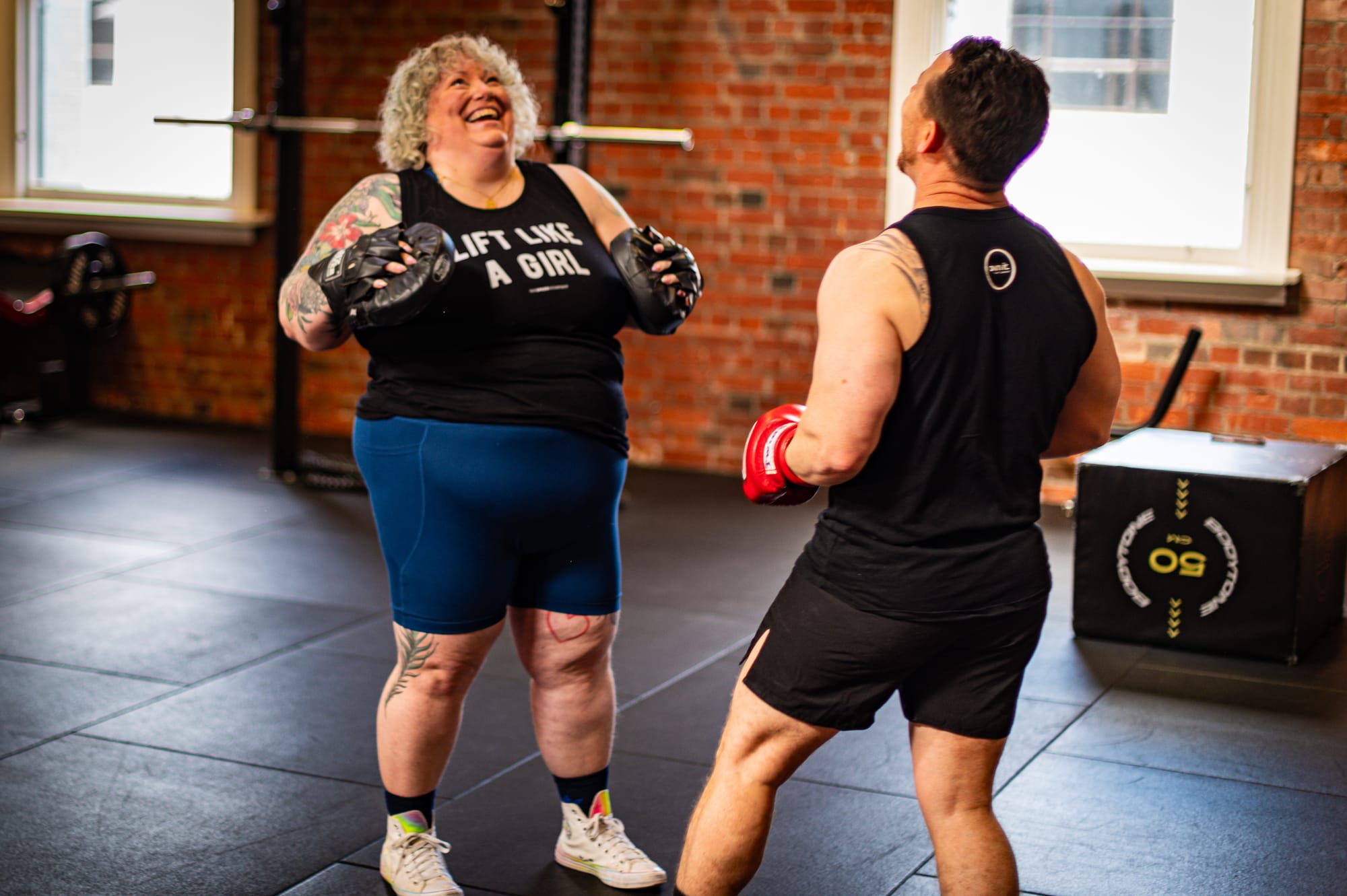
There's one more thing the barbell gives you that the barbell itself can't take credit for, and it's the piece I think matters most for the women reading this. Almost nobody gets strong alone. You get strong in a room with other people, spotting each other, counting each other's reps, celebrating a first pull off the floor. That room does its own work. A systematic review of intervention studies found that group exercise, specifically the version where people train alongside each other rather than beside strangers, was one of the components most consistently linked to reduced loneliness, more so than solo activity.
Community-based exercise classes have separately been shown to reduce loneliness and improve social connectedness. Most of that research is in older adults rather than women specifically, but it lines up exactly with what I watch happen at HealthFit. Someone arrives to train their body and, without quite meaning to, ends up with a group of people who notice when they're not there. For a lot of women who've been sold the gym as a place to shrink themselves, finding it's actually a place to belong is the part that keeps them coming back.
This is the version of strength I want for my girls, Brooke and Alaia. Not strength as a body type to chase, but strength as a set of capacities, physical and mental, that compound across an entire life. I want them to grow up in a gym culture where a woman loading a bar is unremarkable, where "getting stronger" doesn't need softening into more acceptable language, and where the goal is what their body can do for them.
Which is exactly why Megan and I are building the Gains and Brains x HealthFit women's lifting competition. It’s not about the day, it's about creating and supporting a culture of strong women.