
Put a ring on it
I was having a conversation with a fellow Oura-wearer during the week, and I asked how she slept. Before answering, she took out her phone to consult the Oura app.
“You know you can just decide how you slept, eh? You don’t have to look.”
“I know, I was just wondering if the score matched what I thought.”
It is just possible that I am a bit of a hypocrite. The Oura app is one of the first apps I open in the morning. (News and email usually come first.) (God, I really miss life before the internet.)
I look at it to see how I slept, and how I have recovered from the exercise and stresses of the day before. It tells me my HRV, my body temperature and my resting heart rate. It knows I am sick before I do. It tells me to move when I have been sitting for too long.
And the irritating thing is, it works.
Carl is going to tell you about the limits of trackers, and yes, they are well known. And it turns out, like most things, if you have more body fat, they don’t work as well.
I rarely look at the “calories burned” bit of the app. I log my exercise and my steps, not to see how much I have burned, but to see which direction the trend is going in. Have I been doing more or less? Should today be a proper rest day, or shall I do some active recovery (lol, I never do).
So yes, take that with a grain of salt. But, here’s the thing, it has made a difference in my life. I have never been a good sleeper. I would happily read or doomscroll into the small hours, wake up exhausted and then zombie through my day. Do that for a few nights, and then crash for 11 hours on the weekend.
Sleep is a whole newsletter, probably a series, but one thing I have learned is that duration is important, but consistency is deeply serious:
Epidemiological evidence suggests that greater within-person consistency in sleep across nights relates to better health and performance, and irregularity in sleep–wake patterns has emerged as a prominent risk factor for incident cardiometabolic diseases and cardiovascular events.
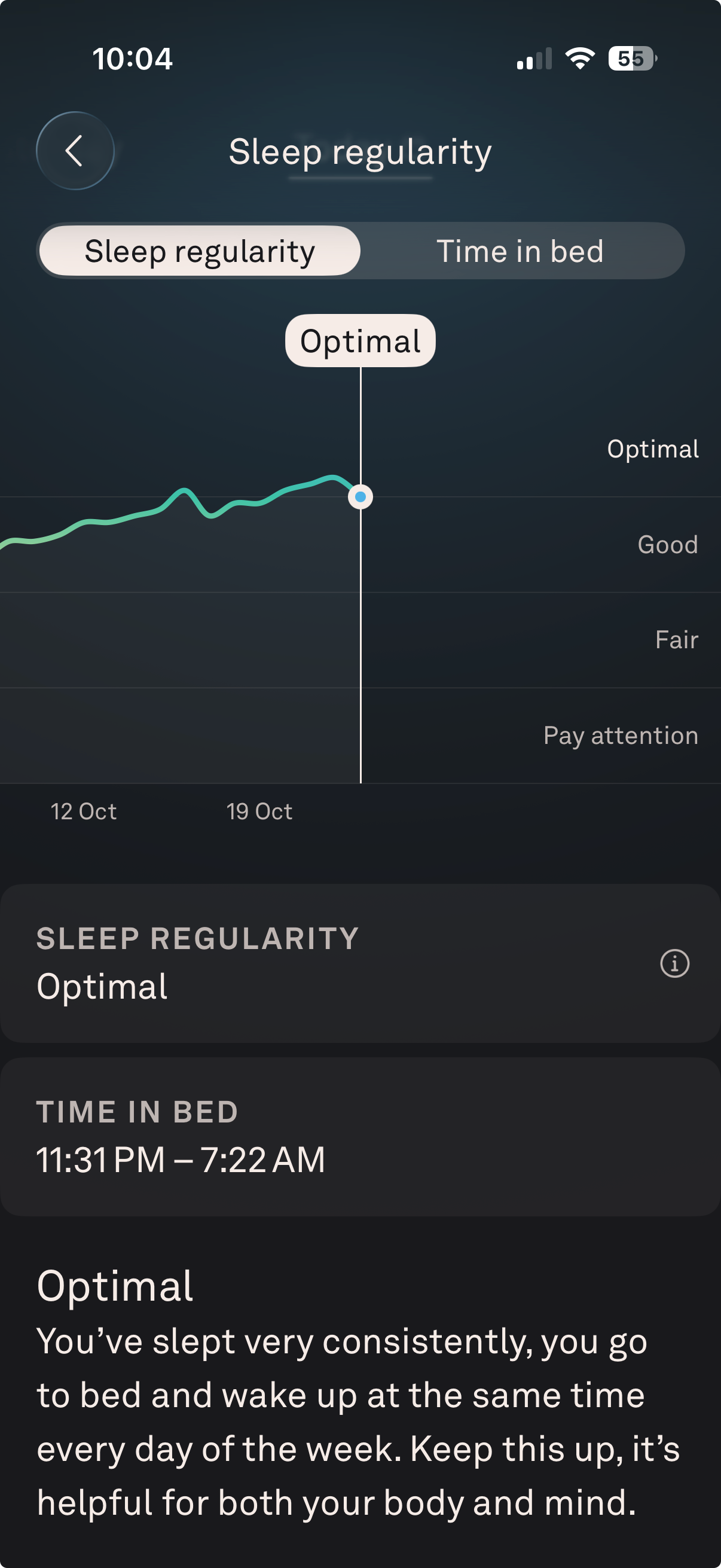
When I looked at the data from my ring, I could see that my sleep times were all over the place and I was recovering poorly on the days where I was up until 1am. The ring didn’t tell me that, but the data it collected showed me.
This isn’t an ad for Oura. I am not gonna give you a discount code. I suspect, if you were a more patient person than me, you could get the same result with a notebook and a pen next to your bed. And a piece of technology having that much of my private information? Not ideal.
I think it is useful though, to understand the bits where your body, your brain and your lifestyle intersect. Alcohol and exercise is another whole series, but seeing the effect even one glass of wine has on my heart rate, there on my phone while I am at the pub, has made me drink less.
We tell you a lot to listen to your body. And you should but sometimes it’s hard. There’s nothing wrong with getting a little help interpreting what she’s telling you.
We’ll do the sleep series. And the alcohol series. Possibly a series about how many series I’ve promised. But for now: use the data until you can read your own body, then trust yourself to decide how you slept. And let Carl tell you the rest.
Carl here…
I've just been gifted an Apple Watch and, of course, I've dived straight into the stats! It surprised me. According to my watch, I'm super fit, super well rested and very resilient. In reality, I feel as unfit as I have in a long while, thanks to a heavier workload and more pressure at work, and I'm not particularly well rested either. Funnily enough, I'm getting a proper fitness test done tomorrow morning, so I'll have an accurate number to report back on.
Megan finds her ring useful, and so do plenty of my clients. More and more, they open a session with me by reading out their watch stats: HRV, resting heart rate, Body Battery, estimated VO₂ max. Sometimes that's useful context. But in some cases I've noticed it has replaced a much simpler question: how are you? So this week I'm looking at when tracking helps, when it gets in the way, how accurate these numbers actually are, and how to use them without letting them do your thinking for you.
Wearables are good at counting and poor at estimating. Used well, they build awareness and habits. Used badly, they replace how you feel with a number that may be wrong.
Does tracking change behaviour?
On average, yes. An umbrella review of 39 reviews found trackers added about 1800 steps a day and around 1 kg of weight loss.
More data is not always better, though. In the IDEA trial, young adults who added a wearable to a weight loss programme lost less weight over two years (3.5 kg versus 5.9 kg).
For training decisions, HRV guided training beats a fixed plan by only a small margin, although it may reduce non responders.
When it backfires
- Enjoyment drops. Across six experiments, Etkin (2016) found measuring an activity made people do more of it but enjoy it less. It started to feel like work, so they did less of it over time. In motivation terms, the number shifts from informing you to controlling you.
- Sleep anxiety. Sleep clinicians coined orthosomnia for patients whose pursuit of a perfect sleep score made their sleep worse. Megan's friend checking her score before saying how she slept is a mild version of this.
The numbers clients bring me
- HRV and resting heart rate. Measured overnight, these are the more reliable numbers on your wrist. WHOOP's sleeping heart rate and HRV closely matched an ECG in a small study (Bellenger et al. 2021). Watch the trend over weeks, not the daily grade.
- Body Battery and readiness scores. These are composite scores, not measurements. The makers don't publish how they're calculated, and independent validation is thin. Treat them as a prompt to check in with yourself, nothing more.
- Estimated VO₂ max. It's a ballpark. The Apple Watch underestimated lab tested VO₂ max by about 6 ml/kg/min in a fit group (2025 validation study). Another study found it overestimates in less fit people and underestimates in fitter ones (2024 validation study). Again, the direction matters more than the number.
What about intuition?
Your sense of effort is better than you think, and it improves with practice. Lifters misjudge how many reps they have left by about one rep on average (Halperin et al. 2022). Accuracy improves near failure and with heavier loads (Russo et al. 2025). Even coaches read effort best late in a set (Emanuel et al. 2022).
In practice
- Track to learn, then step back. Use the data for a block to calibrate your feel, then trust your feel. As Megan puts it, use the data until you can read your own body.
- Read trends, not verdicts. Compare weeks against your own baseline, not one night or one session.
- Let feel win the tiebreak. Rested but scored badly? Believe your body.
- Use the right tool. Wear a chest strap or arm band for lifting, and ignore the calorie estimate.
- Watch the warning signs. If tracking feels like a chore or causes worry, take a break from it.
- Ask the simple question first. Before you check your watch, decide how you feel. Then see whether the data agrees.
How the devices compare
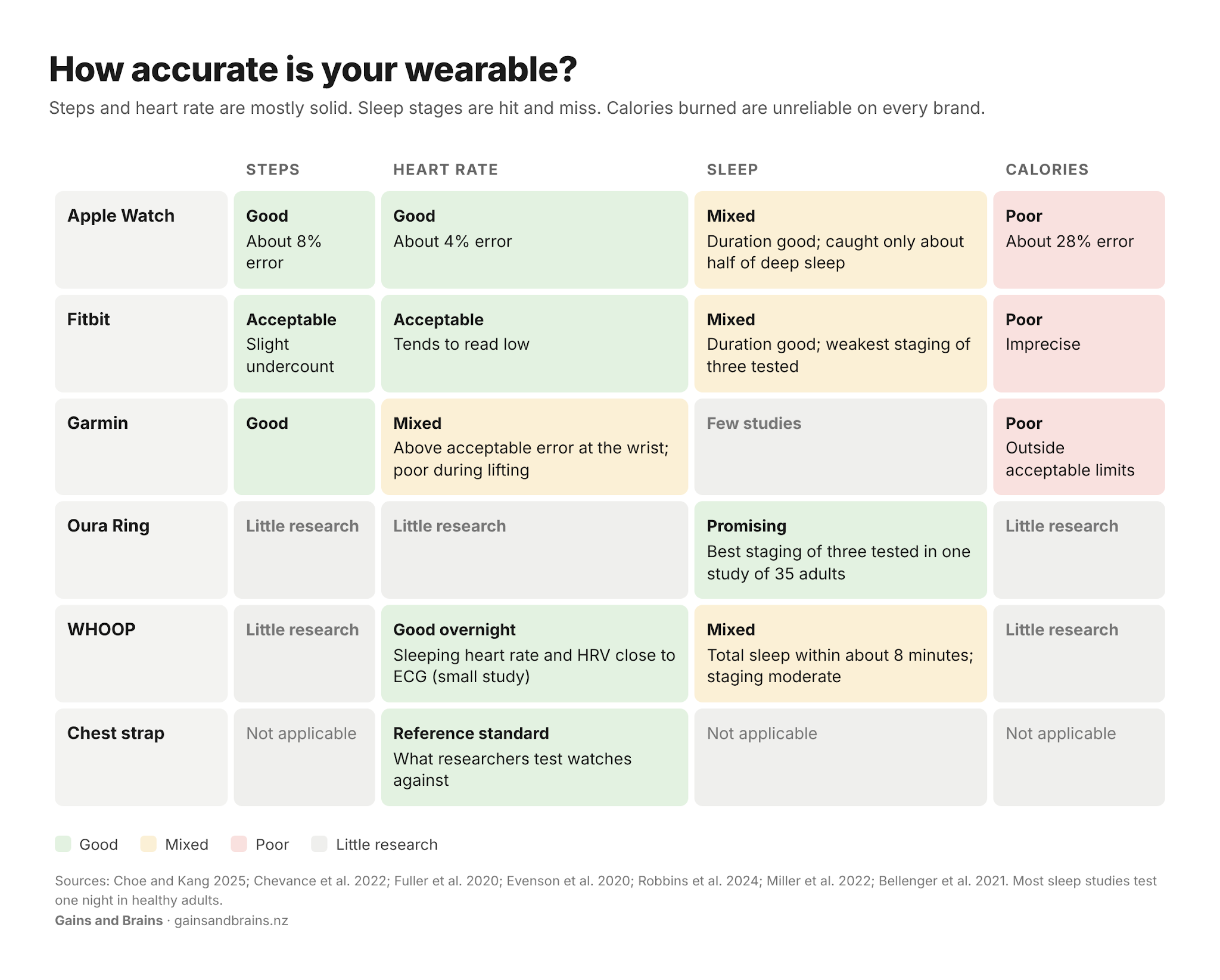
Read the table with care:
- Calories: no brand estimated them accurately (Fuller et al. 2020).
- Sleep: most studies test one night in healthy adults (Robbins et al. 2024).
- Apple Watch: figures come from a 2025 meta-analysis of 56 studies, linked via the university release.
- Fitbit and Garmin: see the Fitbit meta-analysis, the Garmin review and this wrist heart rate study during lifting.
- Oura: the result is one study of 35 adults, and Oura has promoted it heavily. Treat it as promising, not settled.
- WHOOP: see the sleep validation and the small heart rate and HRV study.
- Body size: sleep tracker accuracy varied with BMI in an 11 device study (Lee et al. 2023), which partly backs Megan's point.