
Gains & Brains: Today's Tigers

Carl here.
Let’s talk about stress. What it actually is. What contributes to it. What we can do about it. And the big question that sits underneath all of that, is stress actually bad?
First, we need to acknowledge something important. Your stress response is not a design flaw. It is a survival feature. If a tiger jumped out in front of you, you would want your heart rate to spike, your focus to narrow, and your body to mobilise energy instantly. That rapid fight or flight response is what kept our ancestors alive long enough to pass on their genes.
The problem is not the stress response itself. The problem is that today’s tigers rarely have fur and teeth, and they do not disappear after thirty seconds. Our biology is ancient, but our stressors are modern.
Once upon a time, stress meant an actual tiger. A short, sharp survival problem. Your heart rate spiked, adrenaline surged, glucose was mobilised, and you either ran or fought. Then it was over. The system reset.
Again, biology hasn’t changed much. The triggers have.
Today’s tigers are inboxes, financial pressure, relationship tension, poor sleep, calorie deficits, hard training blocks, injury rehab, parenting logistics, social comparison, and the low hum of never quite being done.

Your nervous system does not distinguish particularly well between a predator and a performance review. If it perceives threat or demand, it activates the same core systems.
At a physiological level, stress is the body’s coordinated response to a real or perceived challenge. The hypothalamic pituitary adrenal axis increases cortisol output, while the sympathetic nervous system elevates heart rate and blood pressure to mobilise energy and sharpen attention.
In the short term, this response is adaptive and performance enhancing. This idea sits within the framework of allostasis, the process by which the body maintains stability through change. Problems arise when demands are high and persistent, creating what researchers call allostatic load, the cumulative wear and tear of chronic stress on the body (McEwen and Stellar, 1993; McEwen, 1998).
Not all stress is bad. In fact, none of your training gains occur without it. Resistance training is a stressor. High intensity conditioning is a stressor. Learning a new skill is a stressor. Hans Selye described this decades ago in the general adaptation syndrome model. An appropriate dose of stress followed by sufficient recovery leads to adaptation. Too much stress, or too little recovery, leads to stagnation or breakdown (Selye, 1956).
This is where the stress bucket analogy becomes useful.
Imagine you have a bucket. Every stressor in your life is a tap filling that bucket. Training stress. Work stress. Relationship stress. Sleep debt. Illness. Travel. Calorie restriction. Even positive life events turn the tap on. The bucket does not care whether the stress is good or bad. It only responds to total load.
When the bucket overflows, the signs are usually obvious. Irritability. Poor sleep. Reduced motivation. Brain fog. Small aches turning into injuries. Decreased training performance. Often the workout gets blamed, but the workout was just one tap among many.

The first skill is awareness. Which taps are actually on for you right now. Not in theory, in reality. Are you in a calorie deficit. Are you sleeping six hours. Are you pushing a heavy training block. Are you managing family or work strain. You cannot manage stress load without accurately accounting for it.
The second skill is regulation. You have two options. Turn taps down, or increase the size of the bucket.
Turning taps down may mean reducing training volume for a week. Eating at maintenance instead of pushing a deficit. Saying no to something non essential. Going to bed earlier. These decisions reduce total load.
Increasing bucket size is about building stress resilience. Regular resistance training improves tolerance to physical and psychological stress over time. Aerobic training improves autonomic nervous system regulation. Adequate sleep improves emotional regulation and reduces next day stress reactivity. Social connection buffers stress responses. Even simple breathing interventions can acutely reduce sympathetic activation and cortisol output (Thayer et al., 2012; Walker, 2017).

There is also a cognitive layer to stress that matters more than most people realise. In the TED talk Making Stress Your Friend, psychologist Kelly McGonigal describes research showing that how we interpret stress changes its physiological impact.
In a large longitudinal study, people reporting high stress had an increased risk of mortality only if they also believed stress was harmful. Those who experienced high stress but did not view it as damaging did not show the same increase in death risk (Keller et al., 2012). In other words, mindset shapes biology.
This does not mean stress is harmless. Chronic stress still carries real physiological costs. It does mean that interpreting stress as a sign your body is preparing you to meet a challenge, rather than as a sign something is wrong, can shift cardiovascular and hormonal responses in measurable ways (Jamieson et al., 2013). This means that how we perceive stress will probably be how our body responds to it! Meaning if we think its bad, it probably will be, and if we think it's a good challenge that will allow us to learn and grow, it probably will be!
For the Gains and Brains community, the takeaway is simple.
Training is stress. Work is stress. Parenting is stress. Rehab is stress. None of this is a moral issue. It is load.
Each week, ask yourself which taps are on. Be specific. Then decide deliberately how and where you will empty the bucket. Sleep. Enough food. Daylight. A genuine rest day. A walk without headphones. A conversation that is not transactional. If life stress is high, adjust training stress accordingly. That is not weakness. That is intelligent programming.
The goal is not to eliminate stress. That is neither possible nor desirable. The goal is to dose it, recover from it, and occasionally reframe it. Today’s tigers are not going away. But you can learn to work with your stress response rather than constantly fighting it.
And as with most things that matter for health and performance, the win is not one perfect week. It is the steady management of load over time.
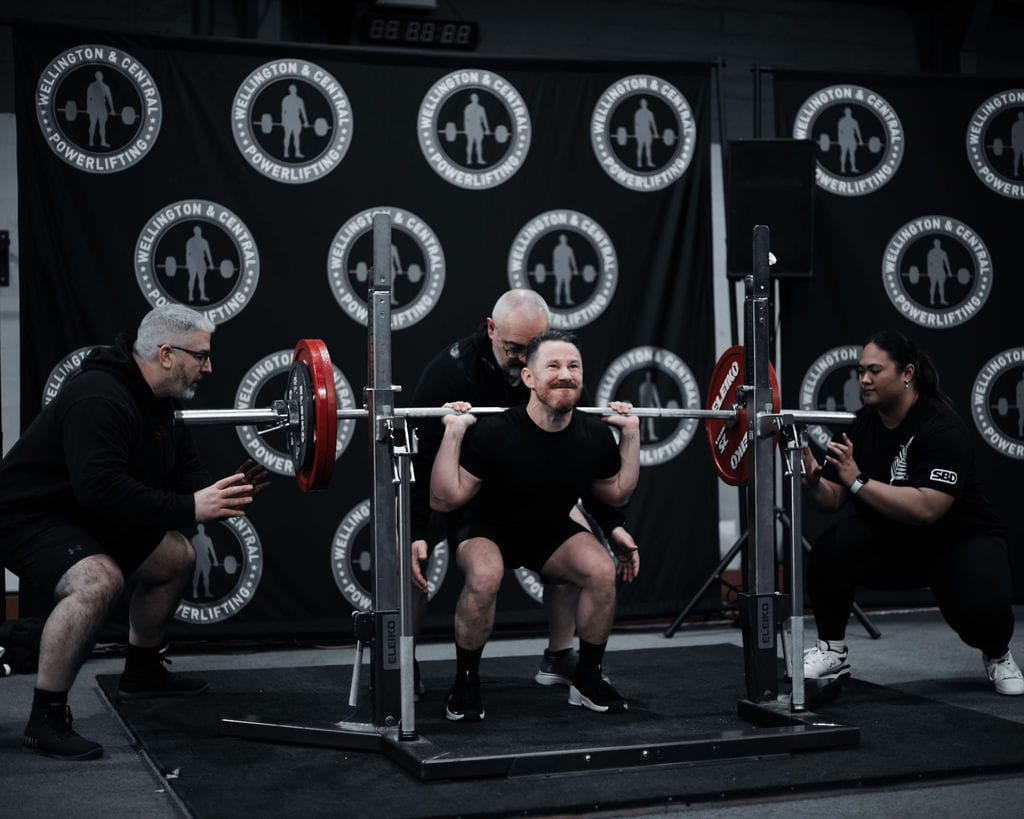
Megan here! Below, there are some helpful “what are your stressors,” and “what can you do to help reset your nervous system” lists. But first, allow me to respond to this very clear dig from my pal Carl.
(She joked.)
I used to be a person who prided herself on not getting stressed. I breezed through life, joking that I was “better under pressure” and “eh, I guess I am just not a very stressful person.”
My body would like words with that version of myself. Because it is now bearing the brunt of a couple of years of chronic stress.
As a certified anxious girlie, my body doesn’t know the difference between my bestie not replying to my text for 2 hours and a marauding wild animal. My body reacts to heavy deadlifts and being told off at work in surprisingly similar ways. The same stress systems fire up, heart rate rises, energy mobilises. The difference is what happens afterwards. From deadlifts, my muscles repair and recover. Thoughts… keep me awake at 2am wondering where I went wrong with it all.
The best feature of my Oura ring is the ‘daytime stress’ graph. It’s measuring heart rate, temperature, breathing rate, HRV, and movement. Oura is at pains to point out that it’s measuring physiological stress - it could be good things that are causing your stress to spike, as Carl says.
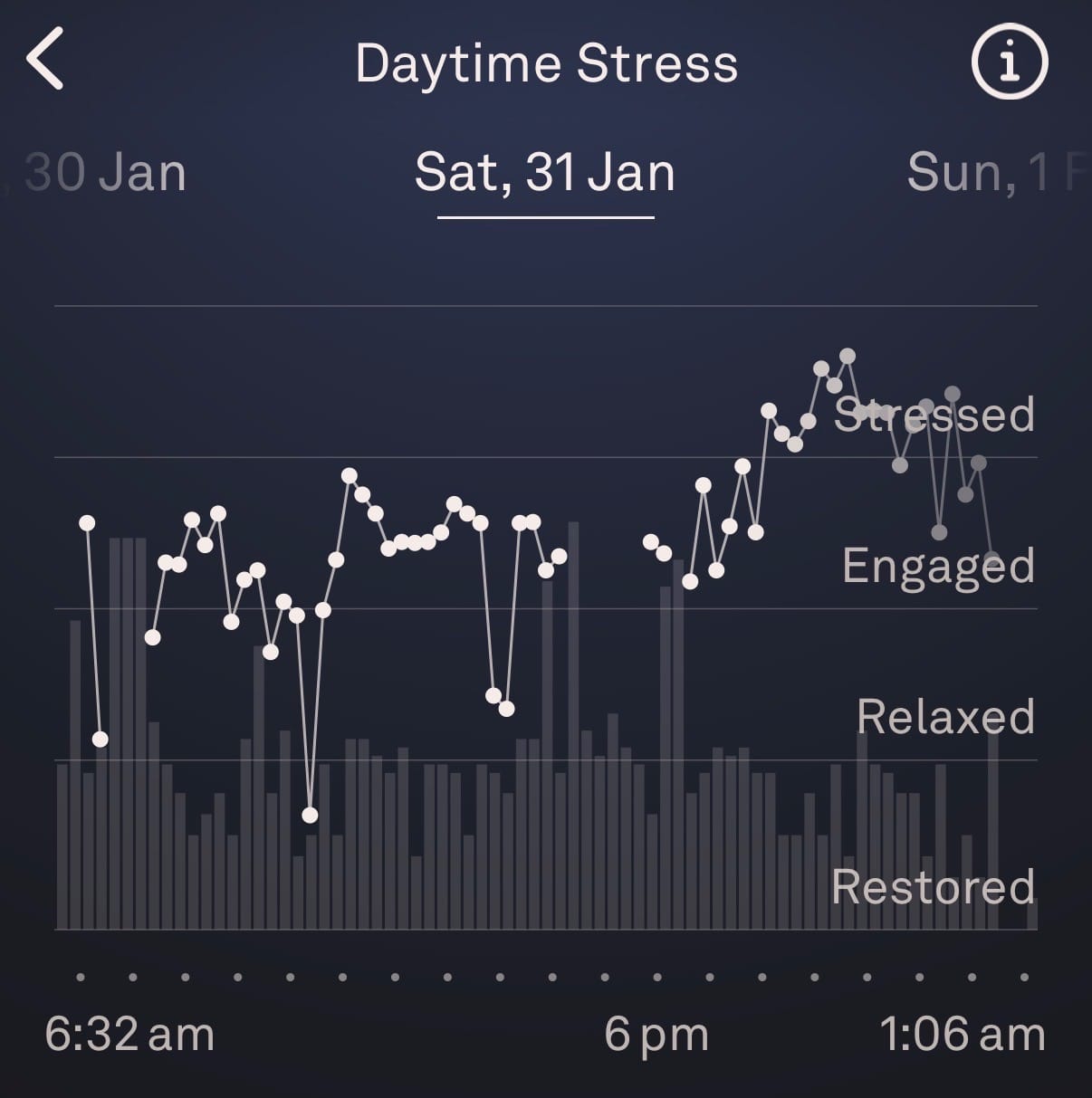
Carl talks about stress as load. Watching that graph has made that idea very literal.
For example, my nightly scroll - even if it’s watching cute animal videos - puts me up into the stressed part of the graph. Reading an actual paper book puts me down in “restored”, but reading a book on my phone does the opposite. Writing chills me out, as does cooking. The most reliable way to get my body in the restorative zone is to put my head on my boyfriend’s chest. (Sorry, vom.)
I went to see my GP at the end of last year, and said “I don’t know why I am tired all the time. I am doing all the right things. I exercise, I am barely drinking, I don’t smoke, I eat the protein and the fibre and and and and.”
After a brief conversation, she looked at me and said “have you thought about maybe being a little kinder to yourself?”
If stress is a bucket, burnout is that bucket getting smaller and smaller by the day, until your life is pouring into a shot glass.
And given the general state of *waves hands at the world* everything, chronic stress is starting to look less like a personal failing and more like a perfectly logical response.
Last week, Carl and I decided that for the next couple of months, we were going to strip my training right back to basics. Mobility, light weights, walking, and get my knee and back ready to ramp up for later in the year. Best laid plans.
If you follow my insta, you may have seen that instead of starting that journey, I had an altercation with the flight of stairs and am now on crutches. I am deeeeeeeeeeply frustrated. With my body, with a healthcare system that is making me wait weeks without telling me what’s actually wrong, and what I am supposed to be doing, and with, well, enforced rest.

But one of the other trainers at the gym, delightful Ruby, said this to me:
“The smarter you heal the sooner you can recover. Realities of being a lifter, tough girl shit.”
So, instead of forcing myself to get better as fast as possible, I am trying very hard to actually rest. To restore. That doesn’t mean following the wellness gurus’ advice and having lots of baths with splinky splinky music and magnesium salts*. It means turning off as many of the taps as I can, for now.
I am absolutely capable of adapting to stress. My biceps are testament to my body's ability to do that. But right now, the load exceeds capacity. Too many taps, not enough bucket.
I will be back in the gym next week, learning to navigate crutches and how I can keep engaging my glute when I can't stand on one leg. I am sure Carl will find a way. But for now, I am quite literally taking a load off.
Because sometimes, recovery isn’t something you add. Sometimes it’s what happens when you finally stop adding things.
So what are your tigers:
If stress is total load, the next step is identifying where that load is actually coming from….(a non-exhaustive list)
Physical Stressors
- Hard training blocks
- High intensity conditioning
- Very high step counts without recovery
- Injury and rehab
- Poor sleep or short sleep duration
- Illness or infection
- Chronic pain
- Calorie restriction or aggressive dieting
- Dehydration
- Excess alcohol
- Long haul travel and jet lag
Psychological stressors
- Work deadlines and performance pressure
- Financial strain
- Job insecurity
- Major life decisions
- Information overload
- Constant notifications and digital interruption
- Perfectionism and unrealistic standards
- Fear of failure
Emotional stressors
- Relationship conflict
- Parenting challenges
- Caring for ageing parents
- Loneliness or social isolation
- Grief or loss
- Feeling undervalued or unseen
- Social comparison
Cognitive stressors
- Learning new systems or roles
- Multitasking constantly
- High responsibility with low control
- Decision fatigue
- Uncertainty about the future
Environmental stressors
- Noise pollution
- Crowded spaces
- Long commutes
- Lack of daylight
- Extreme heat or cold
- Poor air quality
- Climate Change and related events
Social stressors
- Conflict within teams
- Lack of belonging
- Cultural pressure around body image
- Online criticism
- Community expectations
- Discrimination, prejudice, or systemic bias (racism, sexism, homophobia, etc.)
Positive stressors
- Starting a new job
- Launching a business
- Getting married
- Having a child
- Buying a house
- Training for an event
Now, choose some relevant and applicable bucket emptying strategies to help create a plan. The goal isn’t to eliminate stressors. It’s to keep load and recovery in balance:
Physiological recovery
- Prioritise seven to nine hours of sleep
- Keep consistent sleep and wake times
- Eat enough total calories, especially during hard training phases
- Hit adequate protein intake to support repair
- Hydrate properly
- Build in at least one genuine rest day per week
- Use lighter deload weeks during high stress seasons
- Get morning daylight to support circadian rhythm
Nervous system regulation
- Slow nasal breathing for five minutes
- Longer exhales than inhales to shift toward parasympathetic tone
- Low intensity aerobic work like walking or cycling
- Time in nature
- Sauna or hot baths if tolerated
- Short body scans to downshift arousal
Psychological strategies
- Write down what is actually stressing you instead of carrying it cognitively (journal)
- Separate controllables from uncontrollables
- Reduce exposure to unnecessary inputs like constant news or social media
- Chunk large problems into next small actions
- Reframe stress as preparation rather than threat when appropriate
Social buffering
- Have one real conversation per day that is not transactional
- Ask for help early rather than at breaking point
- Train with others when possible
- Spend time with people who reduce, not increase, pressure
- A 7 second hug
Load management
- Adjust training volume when life stress is high
- Avoid stacking aggressive dieting with heavy training and poor sleep
- Plan recovery weeks around predictable busy periods
- Say no to optional commitments in peak stress seasons
Micro recovery habits
- Five minute walk between meetings
- Phone off for the first and last thirty minutes of the day
- Eat meals away from screens
- Two to three slow breaths before responding in conflict
- Set a clear end point to the workday
* Full disclosure, I have no idea if magnesium salts are what is recommended, or what they even are…