
Creating Your Own Programme
A few weeks ago, we dropped a survey asking you what you wanted more of. If you didn’t get around to it, you can still fill it out here.
One of the things we asked for was your questions, and you delivered: Megan’s diabetes, what she wears to lift (oh, I have many recommendations), peptides, how to fuel your body for weight training (great question), and “the aging female athlete” (HEY).
Over the next little while, we’re going to work through some of these. If you’ve got more questions, please keep them coming.
Onto this week’s question, which is a very good one:
“It's not exactly your type of content but the most confusing thing to me in the fitness world is knowing if I'm putting together the right exercises to support my goals (can't afford a PT to help), so always interested to hear more about why coaches recommend this vs that.”
Megan here: honestly, this is such a good question that I’m also looking forward to reading Carl’s answer.
I will first gently suggest that, unlike me, you don’t have to become besties with your trainer and then pay him to hang out with you twice a week. You can, it turns out, see someone a couple of times, get them to write you a programme, and go about your business.
One of my friends describes it like this: you’d get a plumber to fix your piping. Why wouldn’t you rely on the expertise of a personal trainer? If you can swing that, it’s totally worth it.
I follow enough lifters on the socials that I see a lot of programming. Including elite lifters with coaches who are programming individual lifts that look like “deadlift: 170kg x 3 at RPE 8.” Sometimes I forget I am not an elite lifter and wonder if that’s what I should be doing.
What I have learned is that, no matter what your goal is, consistency is usually what gets you there.
This will surprise absolutely nobody who knows me, but consistency does not come naturally to me. I am much more at the “OOOOH, SHINY” end of the spectrum. It helps enormously that I can open an app and see what Carl has programmed for me.
(And then immediately swear when I discover he’s programmed walking lunges.)
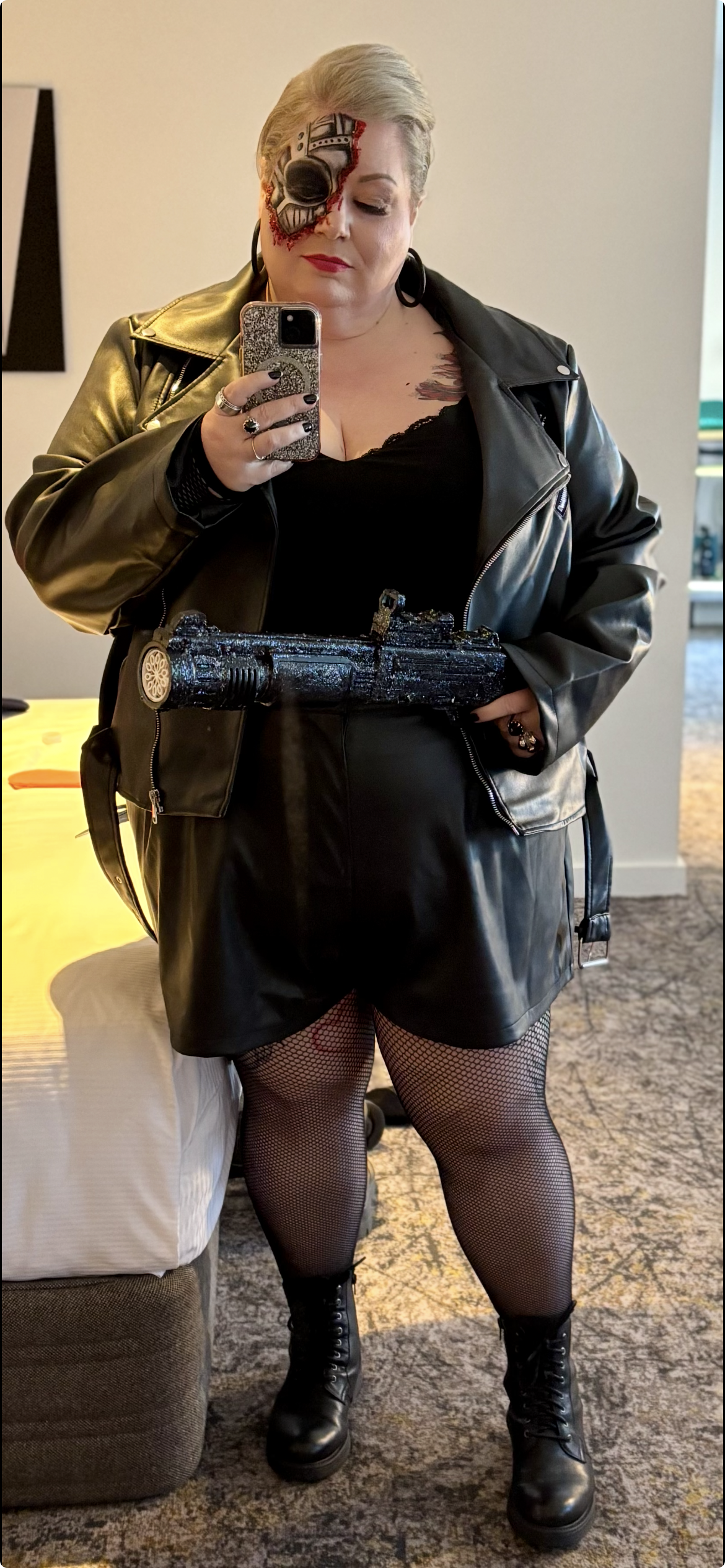
Programming usually happens around a goal: the Torque training block, powerlifting prep, the time I dressed as Terminator for Halloween and wanted massive shoulders.
Right now, because of my knee, travel, and job hunting, things feel a little less structured. At some point soon, Carl and I will probably sit down over coffee and set some new goals beyond “maybe I’ll get a pull-up while rehabbing my knee.”
In the meantime, I’m largely on my own recognisance outside our sessions. Not entirely alone - we text between sessions, and he’s often somewhere across the gym watching me make questionable choices.
But here’s the big thing I try to remember: muscles respond to consistency, not chaos.
If I do wildly different exercises every time I walk into the gym, it becomes really hard to track progress. Am I getting stronger? Better conditioned? More mobile? Or am I just sweaty? Am I doing progressive overload, or just making everyone - especially myself - confused.
So right now, my split looks like this:
Day one: Upper body / benchHeavy bench, then accessories depending on time and energy: cable rows, pulldowns, shoulder press, biceps/triceps, Arnold press.
Day two: Knee rehab / lower bodyPenguin walks, RDLs, and this week Carl and I tested hip thrusts to see whether my knee would tolerate them. Excitingly, it did!
Day three: Upper body / pull focusDumbbell press, bent-over rows, dead hangs, cable flies, lateral raises. (I love a lateral raise with an unreasonable passion.)
Day four: Lower body rehabSimilar to day two, plus single-leg RDLs and step-ups.
I throw cardio in where it makes sense, do mobility as part of my warm-up (and occasionally when guilt strikes), and I’m trying to respect the fact that healing requires actual rest days.
Oh, and I keep track of all of this. I know whether I am getting stronger because two weeks ago I could do 8 bicep curls with the 9kg dumbbells and this week I could do 10. I know that because I kept a note of it.
And in writing this, I have realised something: rehab is the goal right now. I do have a programme. It’s just designed by Riley, my physio, in collaboration with Carl. Look at me, actually doing my physio.
So, that’s my two cents. I am intrigued to hear how Carl decides what goes where. And how he knew never to programme burpees for me.
Carl here
This is a big question and I'll try to shine some light on the process I go through.
First, it's important to note that there are many modes of exercise and movement, from base level (simply being active) to sports-specific training. For general wellbeing, I've put together our Movement Pyramid. It draws on the highest-quality research from the past decade with a "healthspan" filter, meaning it's designed to guide a long and happy life, not to optimise athletic performance.
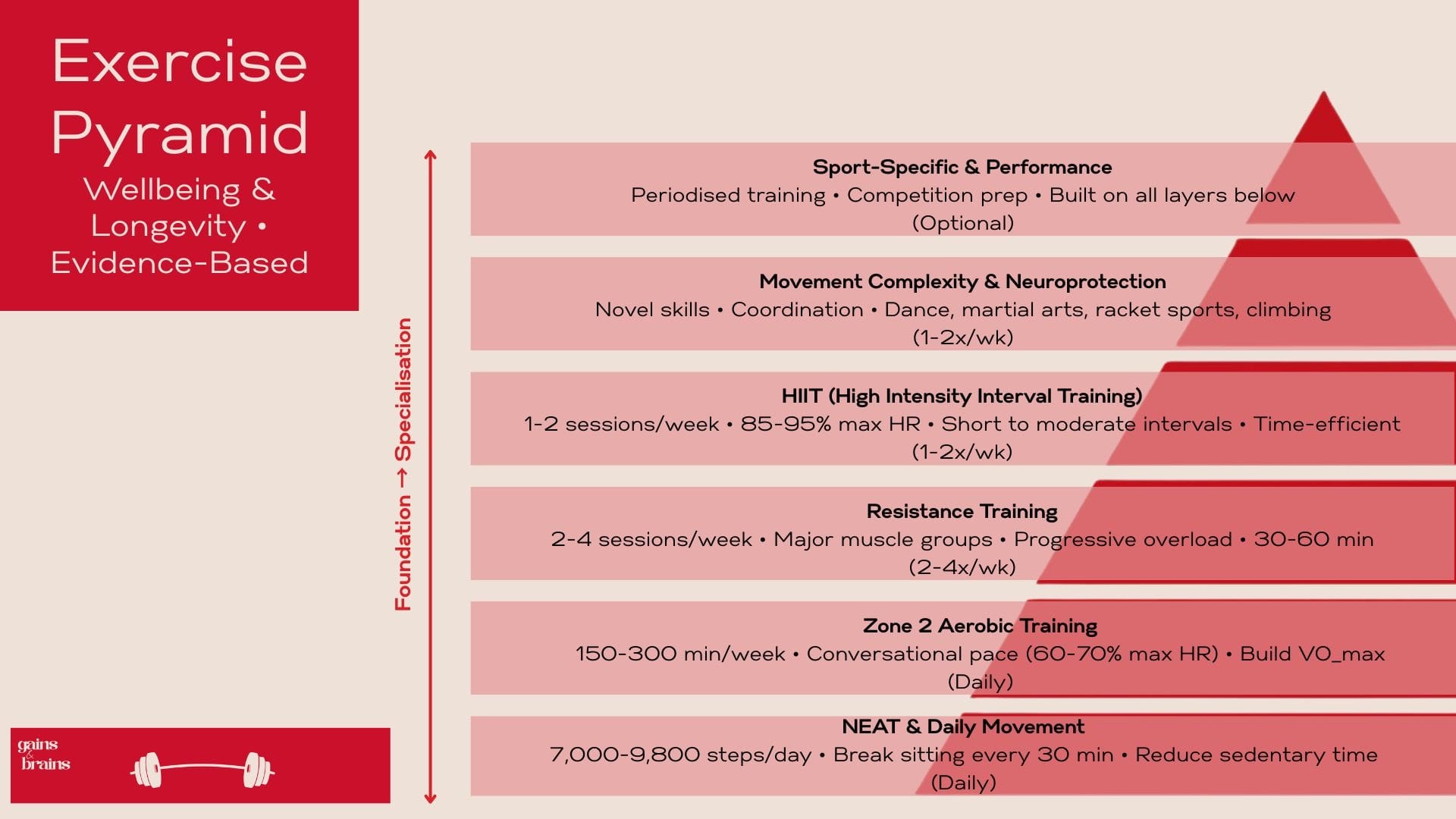
The base layer represents what we can do most throughout the week just to stay well, then we move up into more concentrated modes of exercise. I've even included a layer for neuroprotection and cognitive function. So before you beat yourself up for not making it to the gym, are you active in your daily life? If not, how do we start changing your environment so that movement becomes the default? Then we build the layers of intensity on top of that. You can get some walking into your day, do a quick 2 minutes of ‘movement snacks’ in between meetings or try to become less efficient in your transport. Meaning things like park further away or even walk to work one or two days per week. It all adds up!
You can double up on your modes too, meaning you can do your zone 2 cardio, resistance training and even your complexity movement all in one session. We will really explore this pyramid more in another post!
Now we can get to our gym programme, I have also included some ideas for what you can do at home with no gear.
Always start with the why first! Before anyone talks about exercises, we need to talk about you. Not you in a vague, motivational-poster way, you specifically. Because the "right" programme for a 22-year-old who's been training for three years with no injuries and five free evenings a week looks nothing like the right programme for a 45-year-old with an achy shoulder, two kids, and two realistic gym sessions in her. After you've established this (even a vague idea is fine at first), I think it's important that you find your flavour. Find the type of exercise or movement type or environment that you enjoy as that will increase your likelihood of sticking with it. This could mean the mode of exercise, where you do it or who you do it with, get playful, have fun!
Next up there are a few things I want to know before I write a single exercise:
Training age: Not your actual age, how long have you been doing this, and how consistently? Someone who's been training two years but sporadically is still fairly new to this. That matters, because beginners respond to almost anything (lucky them), and more advanced trainees need more specificity to keep making progress.
Injuries, niggles, and other barriers: Megan will testify that this shapes a lot, right now her entire lower body programme considers a knee. If you've got a cranky hip, a bad back, a shoulder that clicks, or a job that leaves you on your feet all day, that's not an obstacle to work around, it's information to programme with. If you have a bit going on, reach out to a professional if possible or ask us!
What does "available" actually mean? Not what you wish you could do. What can you genuinely, realistically commit to, including how long each session is? Two solid 45-minute sessions beats five sessions you half-show-up to. I'd rather write you two days and have you nail it than six days and have you burning out by week two. Start with a moderate commitment and build from there as you gain momentum. For newbies, 2x per week of resistance training is fine.
What's the actual goal? As we’ve discussed, this will link to the why. But also have a performance goal, something that means something to you. Whether it's enjoying an overseas travel trip full of hikes or doing a pull up. Those are things we can build a programme around and will also help it stick.
For Most People Starting Out: Full Body is perfect
Here's something fitfluencers don't talk loudly enough about: if you're relatively new to training, or returning after a break, a full body programme three days a week will outperform almost anything else.
Why? Because you're training each muscle group three times a week instead of once. Your body is learning movement patterns, the squat, lunge, hinge, push, pull and rotation, and repetition is how it learns. You're also giving yourself room for life to get in the way. Missed a session? You've still hit everything twice.
A simple full body session with weights looks something like:
- A squat pattern: goblet squat, leg press, split squat)
- A hinge pattern: Romanian deadlift, hip thrust, trap bar deadlift)
- A Lunge pattern: weighted lunges, weighted side lunge
- A push: Push up, bench press, overhead press, dumbbell press)
- A pull: row, lat pulldown, cable row)
- Rotation: Cable or band woodchop or a transverse lunge and reach
A simple full body session without weights looks something like:
- A squat pattern: Bodyweight squats, bulgarian split squats, cossack squat (go the hip mobility!)
- A hinge pattern: Single leg toe touches
- A lunge pattern: walking lunge with body weight, lateral lunge
- A push: Push up, pike push up
- A pull: Prone cobra, lying Y-raise
- Rotation: Cable woodchop or russian twist
The programming:
Sets and reps: start with 2 sets of 10-12 reps, controlled tempo around 2s each way with around 60s rest in between sets. Build to 3 sets after 2 weeks. You can use an RPE score to gauge intensity - I would say start at around 6/10 and again, build your effort and intensity over time.
If you want to double up with the cardio component, you can run it like a circuit. Therefore you will get your Zone 2 cardio in also! This would mean run each exercise back to back with no rest and then have your 60s rest after you have done each exercise, and do again! This is what I do if I'm on the road or time poor.
That's it. Pick one or two exercises per category, do your sets, go home. The magic isn't in the exercise selection, it's in coming back next week and doing a little more than you did this week.
Progressive Overload (again!):
Megan mentioned it, she went from 8 reps with 9kg to 10 reps with 9kg and wrote it down. That is progressive overload. That is the mechanism by which your body changes.
Your programme needs to give you a way to do more over time. More weight, more reps, more sets, more quality. If you're doing the same thing every session and not tracking it, you have no idea whether you're progressing. You're just sweaty (her words, and she's right).
This is why consistency in your exercise selection matters so much in the early stages. You can't track progress on an exercise you only do once a month.
When Does a Split Make Sense?
Megan runs an upper/lower split right now. That works well for her because she's been training long enough that her body needs that volume and frequency, and she has a specific reason (knee rehab) to dedicate full sessions to lower body work.
A split starts to make sense when:
- You're training two or more days a week
- You've been training consistently for a while
- Full body sessions are starting to feel too cramped to do justice to everything
- You have a specific goal that requires more volume in one area
Until then, honestly? Full body, two-three days, track your lifts. You'll be amazed at what happens.
On the Burpees, the right exercise, for the right person, at the right time…