No Pain, Maybe Some Gain
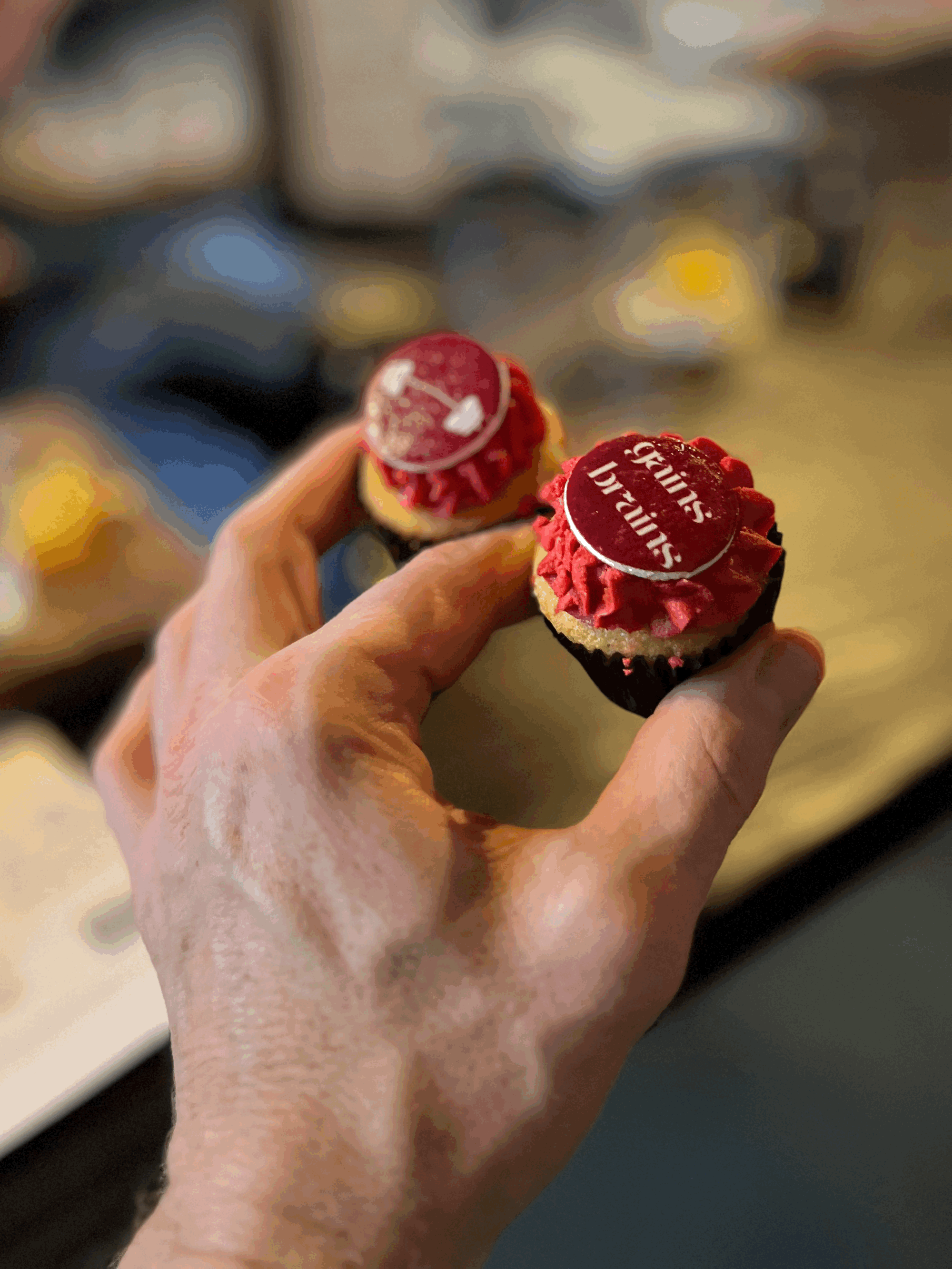
At our wee gathering to celebrate the Gains and Brains birthday, a couple of people asked me how we come up with ideas every week.
The answer is: a lot of ways. Sometimes we see something on social media and it sparks an idea. You’ve sent lots of questions. (Feel free to send more!) Mostly, it’s the chats we’ve had in our sessions.
This week, I am going with the old fashioned kind: making Carl give me free advice about something I need help with.
I’ve reached the point in my injury recovery where i have to start doing some things that cause me discomfort. Not pain, or at least not the bad pain.
I am trying to get better at walking down stairs. I have not stepped down from my affected knee in months. So to start doing it again is a whole process.
I have to psych myself into it, and if I am honest, every time I feel a pang of fear. And then I have to remember exactly how I actually do it. I feel like a toddler re-learning how to walk. I have to think about engaging my glute. And then I have to steel myself for the thunk of my foot landing and the pain thereof.
It’s a weird moment, one hand on the handrail - two if I can - having to actively think how to do a movement I’ve probably done thousands of times in my life. And one which I can do without thinking on the other side of my body.
The fear isn’t psychological. I know that it’s very unlikely that my knee will collapse and I will tumble down the stairs. I even know that the pain of stepping down isn’t that bad, and will be gone by the next step. But I still have to force my body into lifting my foot.
For what it’s worth, I suck at this in all aspects of my life. When I do cardio (gross), I struggle to push myself harder when it gets to the point that I am breathing heavy. In pilates, I am often nervous to push myself into the end ranges. That bit where it starts to feel hard is where I want to stop.
I can’t even pluck my own eyebrows.
Thinking about it this week, I wonder if this is why lifting makes sense to me. Because the discomfort is built in, and is part of progressive overload - so my nervous system doesn’t freak out as much. I don’t feel the same fear, because my body knows it can do it.
When I did my first barbell squat a few weeks ago, the fear was the opposite. I was afraid I couldn’t handle it, that I had misjudged my capability, that my knee actually would buckle under the load. But my body knew what to do - it knew the movement, and how to do it, and I didn’t have to talk it into anything.
I’ve learned to tolerate discomfort when I lift because I can see the benefit. I can see how it works. But I don’t think my brain can tell the difference between stepping off a stair and falling down it right now.
I feel like this is not just a me thing, despite my lifelong inability to wax my own legs. I wonder if part of the reason so many people repeatedly start and fail fitness journeys is something like this. Not laziness or lack of motivation, but because we’re unsure how to push through that discomfort - or even if we should.
Hopefully Carl will have a bunch of insight here, and maybe we can come up with some strategies. We’ve already started working on one.
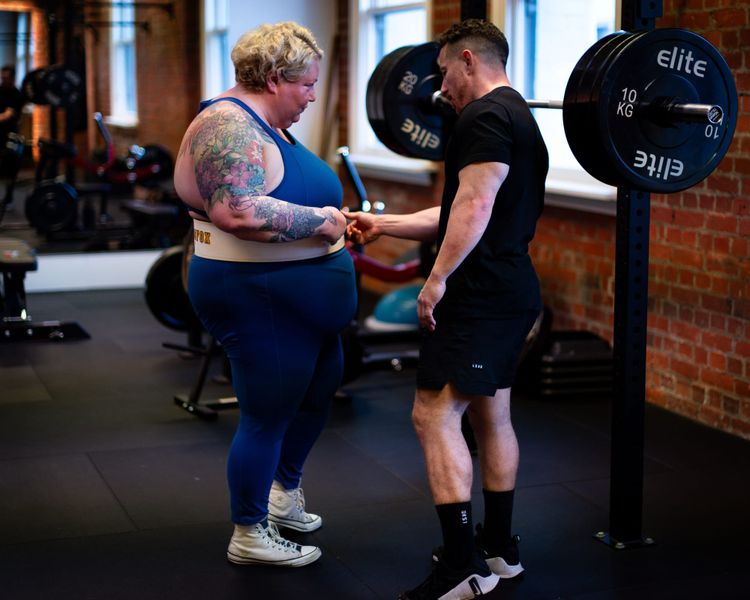
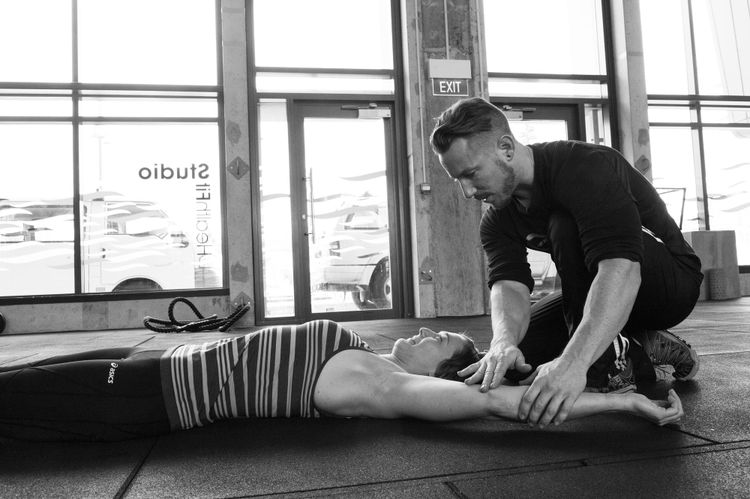
I told him I would like to start working on knee flexion, so we spent our session this week working on lunges. Specifically, walking lunges.
God, I hate him.
At the start of every set, I had to stand there and think about how to do a lunge. What leg I should start with and how to make my knee bend in the right way. I had to make myself push off that leg and take a big step. So at least the awkwardness isn’t just stairs. It’s everywhere!?
And when I said that I was feeling it more in my knee than anywhere else, we slowed the movement right down, so I could concentrate on engaging the glute. Carl’s theory is that walking lunges translate into gait, so when I walk, it should start using more of my glute.
So here I am, sitting on the couch, with one side of my butt aching.
So, Carl, other than cursing your name, what’s your thinking? We don’t advocate no pain no gain round here, but how do I get more comfortable with it?
Carl here...
This is such an interesting subject to explore because this is again in reference to that sticky mid-rehab phase blip, both physically and definitely mentally. I actually love that I get to be the one to step back and remind her how far she's actually come, in a relatively short space of time too. I understand Megan's apprehension around discomfort, and it's completely normal, maybe even a useful thing.
That apprehension is worth pausing on, because psychologists actually have a name for exactly why it happens. It's called the fear avoidance model, and it works like this: you feel pain, your brain treats that pain as a warning sign, the warning sign creates fear of getting hurt again, and that fear makes you start watching your body closely for trouble and avoiding the movements that caused it in the first place. A huge review of over 65,000 people across 335 studies confirms this pattern reliably leads to more pain and more difficulty doing everyday things, not less (Rogers & Farris, 2022). So Megan's caution isn't her "being soft" or overthinking it. It's a completely normal, well documented response, and it sticks around because avoiding the painful thing does bring relief in the moment, which is exactly what keeps the habit going.
Which makes what's happening for her now even more interesting. Megan mentioned something this week: she's doing more in daily life, and more and more often, she's only noticing afterward that something didn't hurt. Not in the moment, just looking back on it. I actually saw this happen in real time: she got excited to see a friend at the gym and ran across the room for a hug, completely pain free and without a second thought. I said to her, "do you realise what you just did then?"
Here's the simple version of why that matters. Constantly checking in on a sore spot (what we'd call hypervigilance) is the opposite of being absorbed in what you're actually doing. When you're scared of getting hurt, your attention stays glued to the sore spot, watching for danger. When trust comes back, your attention naturally shifts to the task itself, like running to hug a friend. So those pain free moments aren't just luck, or "just" the training working. They're a sign that the fear cycle is loosening its grip, which is exactly what we want to see this far into recovery.
There's actually a simple reason this happens, and it comes down to attention being limited, like a phone battery that only has so much charge. Pain has to compete with everything else for your attention. One study had people cycling hard while wearing virtual reality headsets, and found that when their attention was absorbed elsewhere (without it being mentally exhausting), they reported less pain than those with no distraction at all (Wender et al., 2022). The same idea has been tested directly with knee pain. One trial had people focus either on their knee itself, or on the outcome of the movement (like driving through the floor), during a strengthening programme. Those who focused on the movement, rather than the joint, tended to get more benefit overall (Aghakeshizadeh, Letafatkar, & Thomas, 2021). And the good news is this isn't fixed. A 2023 study found that as people's fear and catastrophic thinking about their pain reduced during treatment, their day to day function directly improved as a result, not just alongside it (Ryum & Stiles, 2023).
Which explains the "I only noticed afterward" part perfectly. The moment Megan stops and checks in with herself is the first moment she actually has spare attention to go looking for pain, and she finds none. She's not missing something. She's simply got room to notice, for the first time in a while, that it isn't there.
Cool science that helps us understand the experience! But what can we actually do with it?
Try this: the attention audit
This is a tool that I was reminded of this week by coach Ruby, your attention can drive your experience and pain. So next time you're training, gardening, or doing anything that usually brings on a niggle, try this simple two step check instead of pushing through it or avoiding it altogether:
Before you start, rate the niggle out of 10, then pick something to focus on that's about the task, not the sore spot. Think "push through my heels" rather than "be careful of my knee."
After you finish, rate it again, then ask yourself: was I thinking about the sore spot, or was I focused on what I was actually doing? If the second rating is lower and you were focused on the task, that's not a fluke, it’s science!
Try this too: the hurt vs harm gauge
Not all discomfort during training means something's wrong. This simple three part check helps you tell the difference between pain that's safe to train through and pain that's telling you to back off. It's based on something called the pain monitoring model, originally developed for tendon injuries and since shown to work well across a wide range of pain conditions (Gibbs, Powell, Smith, & Jones, 2025).
During the activity: rate it 0 to 10. Pain up to about a 5 is generally fine to continue through. Above that, it's worth easing off or modifying.
Straight after: has the pain gotten noticeably worse compared with before you started? If yes, that's a signal to scale back next time. If it's similar or only mildly higher, that's normal and expected.
The next morning: has it settled back down to roughly where it was before you trained? If yes, your body's handling the load well. If it's still elevated a full day later, that's the one to actually pay attention to. It usually means the dose was a bit much, not that the activity itself is dangerous.
The rule of thumb: mild discomfort that settles by the next day is a normal part of getting stronger. Pain that escalates during the session or lingers well past 24 hours is the actual signal to adjust.
Try both of these for a week and you'll start to notice your own patterns. When your focus changes what you feel, and when discomfort is safe to train through versus when it's asking you to ease back. That's far more useful than just hoping the good days show up on their own, or guessing at what's safe.