
Just One Squat, as a Treat
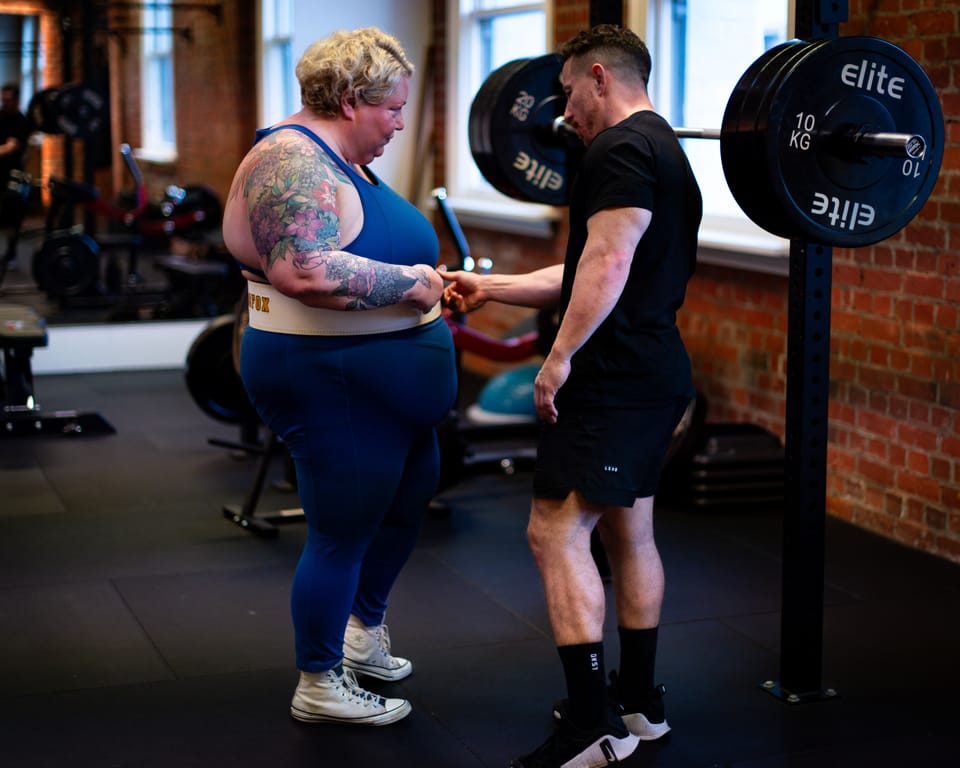
This never happens in superhero movies.
I am in the checkout queue at the supermarket when I get a text: “Hi Megan, your MRI shows a ‘High-grade partial-thickness tear posterior root medial meniscus.’”
On the one hand, what a wonderful thing, to have the resources to get a diagnostic test to find out what the hell has been going on, and now we can treat it.
On the other, did I snort at the phrase “posterior root posterior horn medial meniscus?” Of course I did.
On my third hand, well, fuck.
As much as I am relieved to discover that the knee thing I’ve been battling for months is a proper, grown-up injury, I am also staring down the barrel of not being able to squat anything but my bodyweight for months. It seems likely it will be Christmas before I’m back to what I was lifting last year.
My Instagram feed has been full of reels that basically say “you’ve been handling your injury so well” — jump cut to a panda going absolutely feral and smashing things. The algorithm gets me.

I would dearly love to have a rant about the medical system here, but that’s not what Gains and Brains is about. Still, a bunch of people have told us the injury series has been useful. So, great news! It’s gonna continue.
For the past few weeks, I have been gaslighting myself into thinking “maybe this isn’t that bad. Maybe there’s nothing wrong and I just need to harden up.”(Reader, there was something wrong.)
So, if I am honest, it is delightful to discover that there is, in fact, a legitimate thing to complain about.
And so now, we begin - technically we were already on - the path to recovery. The doctors think I don’t need surgery, so physio it is. Given I have been having physio for some time, I am cool with that. And cognisant that that might be why this injury isn’t even worse.
Carl and I have already decided that while I can’t squat, bench and a pull up is the aim. So I can probably get my heavy lifting fix. And I have been really disciplined about rehab so far, and I feel comfortable that I can continue doing that.
What I am worried about, other than how boring life will be without deadlifts, is my propensity to go too hard.
Quite often, I come home from the gym and complain to my boyfriend that, for example, my shoulder is sore. And he will laugh, and ask if, perhaps, I overdid it. Me? Never.
Even on the same morning as my appointment with a surgeon, who admitted that, as a lifter, the odds I might re-injure my leg in this process are higher than 0, my brain sat in the gym and thought, “OK, but how bad would one squat be, really?”
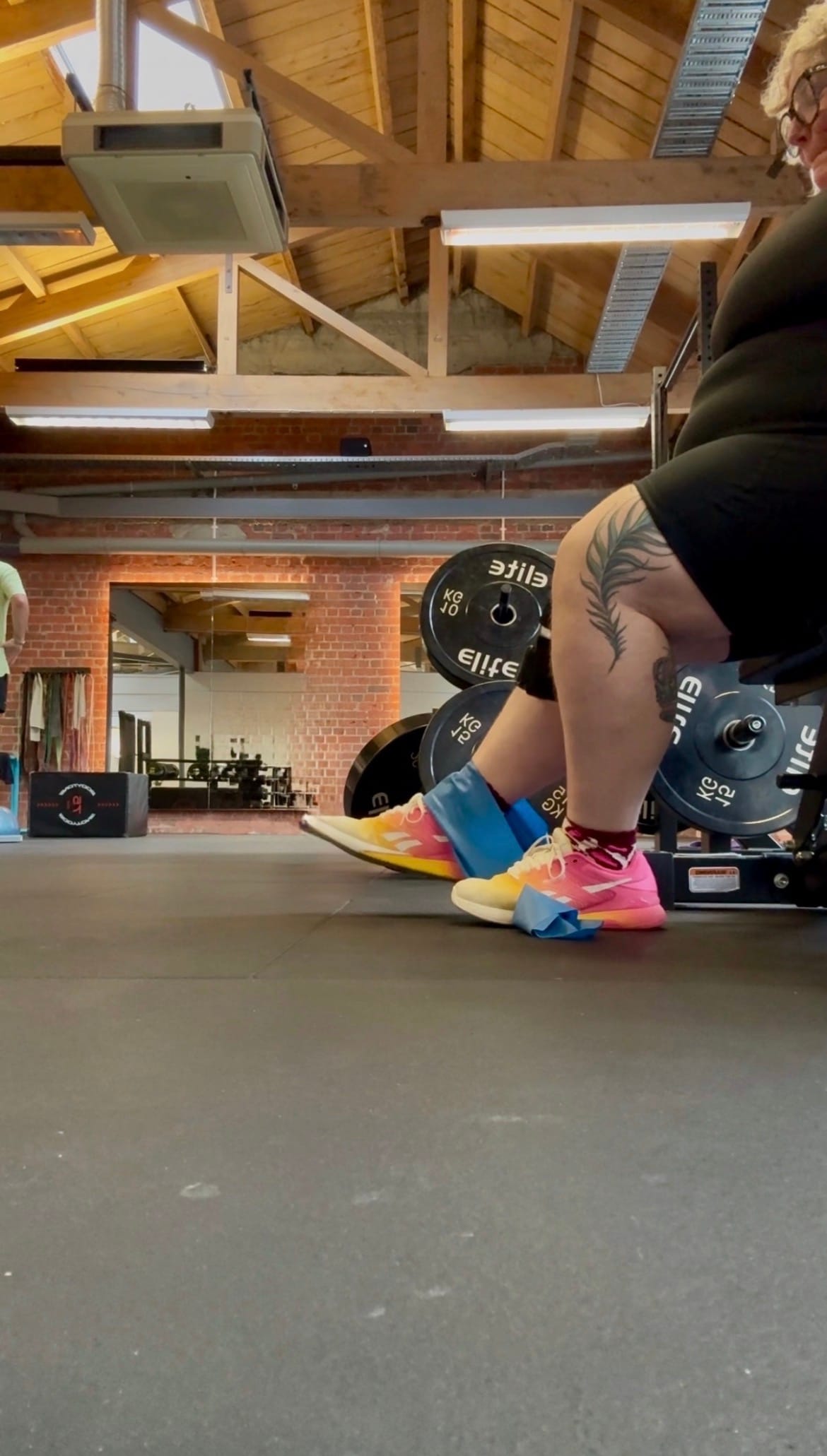
I was sitting on a bench with resistance bands, strengthening my quad, and the thought just popped into my brain. Just one squat, as a treat. Surely my knee can handle one?
I even asked the surgeon this. “How do I stop myself going too hard and making it worse?” - before realising, as I said it out loud, that’s a question I have to answer for myself.
But fortunately for me - and the Gains and Brains community - I have a Carl.
So, my friend: how do I stop myself treating the gym like I have something to prove every time I walk through the door*?
Or is this the work now?
Can you get an A+ in rehab — and is that what I should be trying to do?
* Yes, I am aware there might be something to unpack here.
Carl here, firstly I’m grateful to be ‘a Carl’ for you!
Secondly, the whole “questioning your reality” piece when it comes to injury is incredibly common. I had almost the exact same experience with my own knee. After a decent rugby incident at 19, I was initially told it was a mild MCL strain. Ten weeks of rehab later, my knee was still collapsing under me, I couldn’t cut or sidestep (this was in my rehab protocol), and I started to do what a lot of us do and turn inward, my internal dialogue looked something like:
Maybe I'm not trying hard enough”“Maybe I am being soft.”“Maybe it is all in my head.”
Turns out, it wasn’t all in my head (validating!). A second opinion revealed the full “unhappy triad”, ACL, MCL, and meniscus tear. Not ideal and a full knee reconstruction followed pretty quickly.
All that to say your instinct to question yourself is human, but it’s not always helpful. Pain and injury are not moral tests of toughness. They are information.
Now to your actual question, how do you stop treating the gym like you have something to prove?
Short answer, you don’t just stop. You change the game you are playing.
Right now your brain is wired to chase output, weight on the bar, intensity, the feeling of pushing. That is not a flaw, that is part of what made you good in the first place. But in rehab, that same drive can become the thing that sets you back.
So the work now is not to suppress that instinct, but to redirect it.
There is good evidence in sports psychology that the type of goal you orient toward matters. A mastery focused approach, meaning a focus on process, skill execution, and progression, is associated with more adaptive motivation, persistence, and responses to setbacks compared to a performance focused approach centred on outcomes and comparison (Nicholls, 1984; Dweck, 1986). In rehabilitation contexts, a mastery goal orientation leads to better psychological readiness, adherence, less fear of reinjury, and are consistently linked to positive return to sport outcomes (Ardern et al., 2013).
So yes, this is the work now.
And yes, you absolutely can get an A+ in rehab, but the grading criteria has to change.
An A+ is doing what was prescribed, even when it feels too easy.It may be leaving reps in the tank when you want to push.It might be consistent across weeks, not heroic on one day.It is progressing when it is appropriate, not when it is tempting.
There is also a physiological piece worth respecting. Meniscal tissue, particularly in the posterior root, has limited vascular supply, which constrains healing capacity and makes it sensitive to excessive or poorly managed loading. While appropriate mechanical loading supports tissue adaptation, spikes in load are associated with symptom flares and delayed recovery across musculoskeletal injuries (Khan and Scott, 2009). Once again, enter into the fold ‘progressive overload!’.
From a behavioural standpoint, one of the most useful tools is pre commitment. Decide your session before you walk in, write it down, and treat deviations as breaking a contract rather than just one extra rep. Obviously having ‘A Carl’ helps, or a Riley (physio). This aligns with self regulation research showing that implementation intentions significantly improve adherence to planned behaviours under temptation (Gollwitzer, 1999).
Another is using constraints. Train with someone (hi again!). Use tempo prescriptions or pauses that make it harder to rush or overload. Cap intensity deliberately, for example working at an RPE of 6 to 7 even if you feel good. These strategies reduce reliance on in the moment decision making, which is often where people drift into doing too much.
In saying all of this, we can still get our tin fix and employ some performance goal orientation in our bench press and pull-up endeavours. So I think we can have a bit of both!
It is also useful to zoom out. Rehab is not a pause in your training. It is training, just with a different objective. You are still building capacity, just in a more specific and deliberate way.
You are not losing your identity as someone who trains hard. You are expanding it to include someone who trains intelligently when it matters most. A bit of wisdom sneaking in there perhaps??
For what it is worth, the fact that you have already been consistent with training and physio likely explains why this is not worse. Early and consistent loading within tolerance is associated with better outcomes across a range of musculoskeletal injuries and as I say ‘motion is the lotion’...
Final thought, you asked how do I stop myself.
You probably do not, entirely. That voice might still pop up, just one squat, as a treat.
The win is not silencing it, the win is hearing it and choosing not to act on it.
That is the rep that counts right now.