Gains and Brains: What Makes Us Keep Turning Up
Happy weekend, team. Carl gets the first word this week.
Most people do not quit training because the programme was wrong. They quit because nothing was pulling them back through the door.
Last weekend I presented at the Exercise New Zealand Conference on one question: what makes us keep turning up? Not for six weeks. For six years, or twenty. This week’s newsletter is essentially the write up of those slides, with the research linked so you can dig in yourself.
We look at what the long term numbers actually are, the factors that line up for people who stick, the different flavours of motivation, why the person beside you matters so much, and the one I could talk about all day: play.
The long game: what the numbers say
In a study tracking 5,240 members of a Rio de Janeiro gym over nearly a decade, Sperandei and colleagues (2016) found that 63% had dropped out within three months, and 96% by twelve months. One caveat: they measured membership payments, not actual attendance, so some "stayers" may still have been paying and not coming.
Attendance data paints a similar picture. A Norwegian study of new fitness club members found only 37% exercised regularly, and just 17% used the gym twice a week across their first year.
Why does this matter? Because the good stuff (strength you keep into your 80s, bone density, a calmer brain, independence) is earned over years, not weeks. Stop training and most of those gains slowly slip away. So the most important training variable is not sets, reps or tempo. It is whether you are still here next year.
What the stickers have in common
A big Lancet review by Bauman and colleagues (2012) pulled together decades of research on why some people stay active and others do not. The consistent correlates in adults included health status, intention to exercise, self efficacy and a previous history of being active. Correlates, not causes, but they point in a useful direction.
Three more findings I find practical:
- How it feels during the session matters more than how it feels after. A systematic review by Rhodes and Kates (2015) found that a positive shift in how people felt during moderate exercise was linked to future activity, while post exercise feelings were not. The glow afterwards is nice. The experience in the moment is what brings people back.
- Habits form through repetition in a stable context. Following 111 new gym members, Kaushal and Rhodes (2015) found that at least four sessions a week for six weeks was the minimum to establish an exercise habit. Their advice to trainers: keep things fun and simple for new clients and focus on consistency.
- Why you start shapes whether you stay. In the Brazilian gym data, members motivated by weight loss were among those at greater risk of dropping out. Goals about the mirror tend to be fragile. Goals about what your body can do tend to last.
Notice what is not on that list: willpower, discipline, or the perfect programme.
Not all motivation is equal
We talk about motivation like a fuel tank: full or empty. Self Determination Theory says the type of fuel matters more than the amount. Here is the spectrum, from least to most self driven, as it sounds on the gym floor:
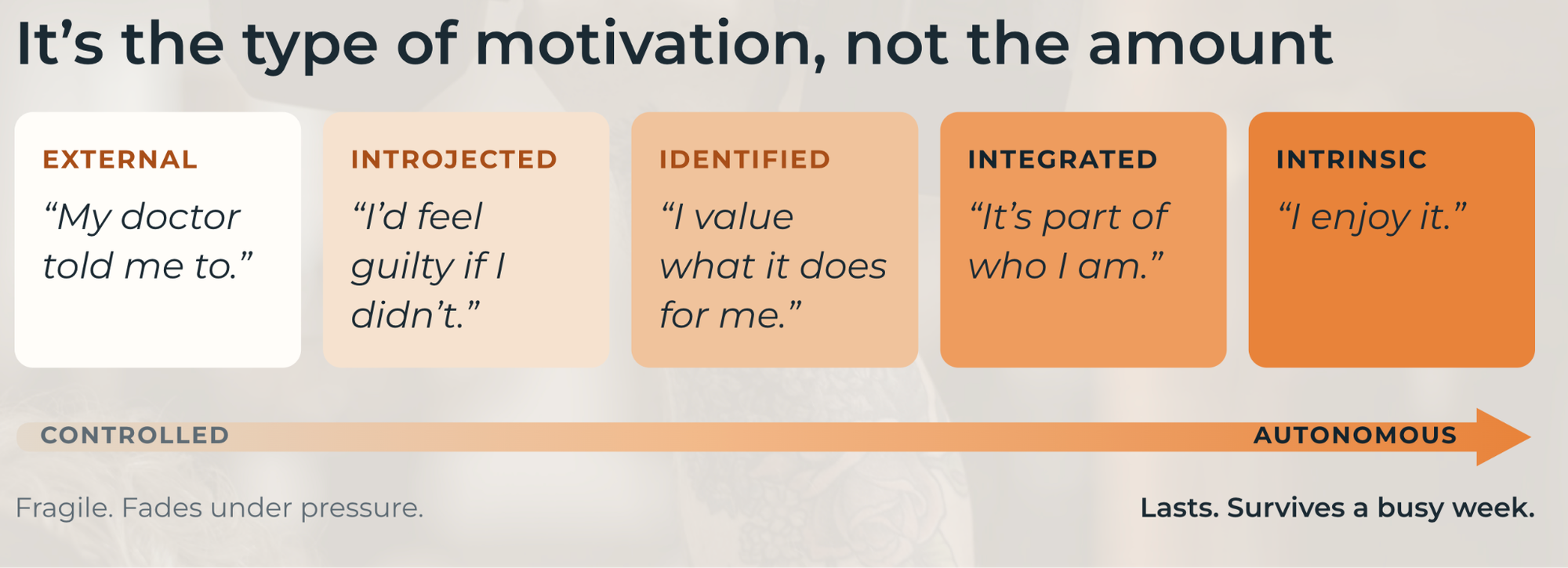
The evidence lines up with the theory. A systematic review of 66 studies by Teixeira and colleagues (2012) found identified and intrinsic motivation were the most predictive of long term exercise adherence. A later meta analysis of 73 intervention studies by Ntoumanis and colleagues (2021) found that increases in need support and autonomous motivation, but not controlled motivation, were linked to positive changes in health behaviour. FWIW, those effects were modest and varied a lot between studies.
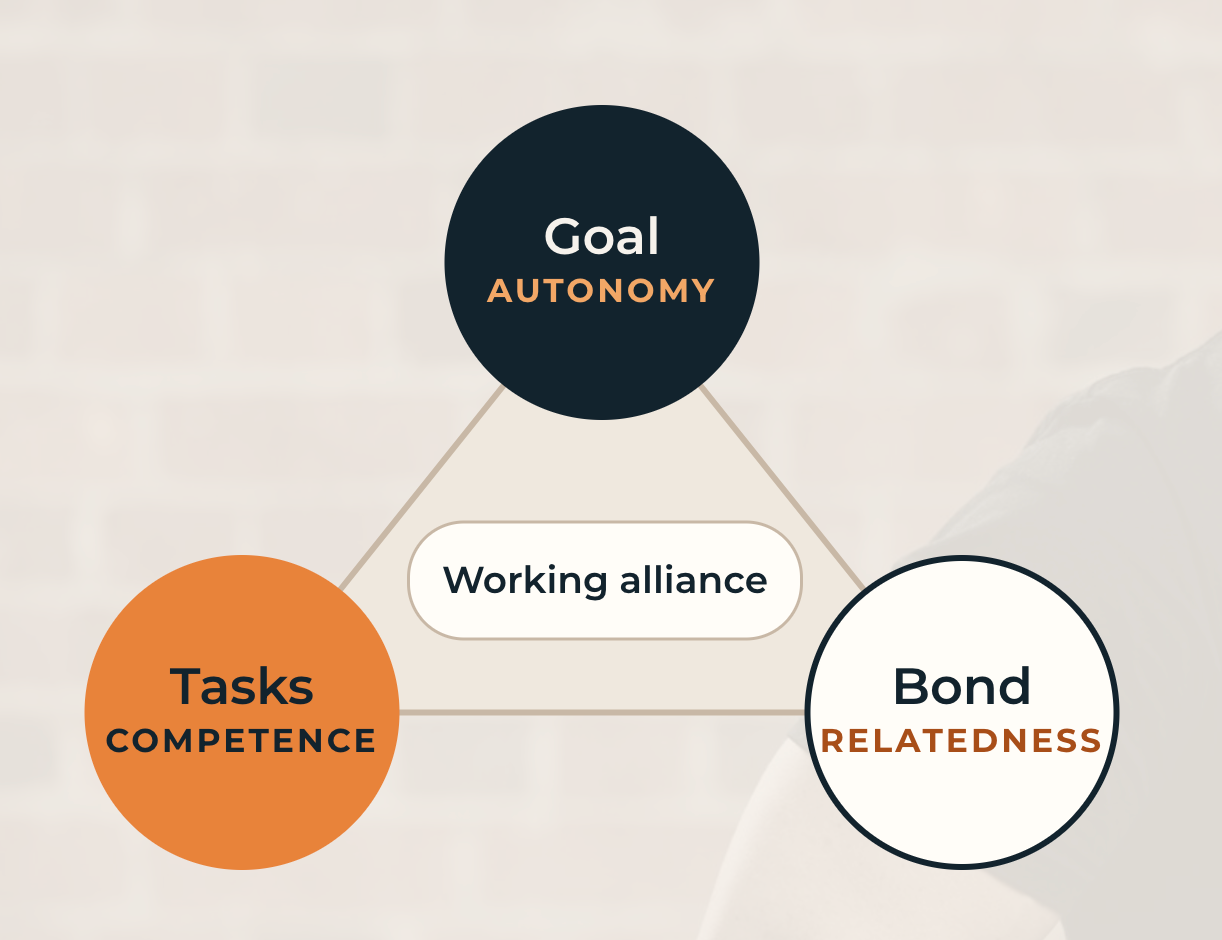
The engine room is three basic needs:
- Autonomy: I have a say in what I do.
- Competence: I can feel myself getting better.
- Relatedness: I belong here and people notice when I am missing.
Guilt and invoices will get someone through the door this month. Ownership, progress and belonging get them through the door for years.
Why the person beside you matters
If you remember one section, make it this one. People rarely stick with training alone.
The coach as ally. In psychotherapy, Bordin described the working alliance as three things: agreement on goals, agreement on the tasks to get there, and a genuine bond. The same idea is now being tested in exercise. A scoping review in BMC Health Services Research (2017) found that 57% of the 26 articles examining it showed some link between the therapeutic alliance and adherence, with autonomy supportive environments linked to better adherence. And in a meta analysis of need supportive techniques, Gillison and colleagues (2019) found one to one interventions produced much greater feelings of competence than group based ones (g = 0.96 vs 0.28). A good coach is not a rep counter. They are the person who helps you feel capable.
The group as glue. A meta analysis of 44 studies by Burke and colleagues (2006) found that exercising in a true group was superior to a standard exercise class, which in turn performed no better than exercising at home with some contact. The key word is true. A room full of people facing the same mirror is not a group. A group has names, shared goals and in jokes.
The partner as a nudge. The Köhler effect describes how the weaker member of a pair tends to work harder alongside a moderately more capable partner than alone. In an exergame study, Feltz, Irwin and Kerr (2012) found an inverted U relationship between partner ability gap and persistence. Translation: pick a training partner who is a bit better than you, not miles better. Too close and there is no pull. Too far and you give up.
Play: the most underrated tool in the gym
Play is not the opposite of serious training. Play is doing something for its own sake: freely chosen, absorbing, a little unpredictable, and enjoyed in the moment rather than only for what it delivers later. Sound familiar? That is intrinsic motivation, the top of the table above.
We accept this easily for kids. In youth sport, the most common reason children give for dropping out is that it stopped being fun. Visek and colleagues (2015) mapped what fun actually means to young athletes, and it was not lollies and silly games. It was things like trying hard, good team dynamics and positive coaching.
Adults are not so different. Proyer (2013) found adult playfulness was linked to life satisfaction and to an active way of life. A follow up by Proyer and colleagues (2018) found positive associations between playfulness and objective measures of physical fitness. The effects are small and correlational, so playfulness is not a fitness programme. But it may help keep people in one. I also had the pleasure of chatting with Professor Scott Duncan at AUT about where play research is heading, and it is an exciting space.
Play can look different for different people, and in adults it's more the mindset behind what you do as opposed to doing the thing.
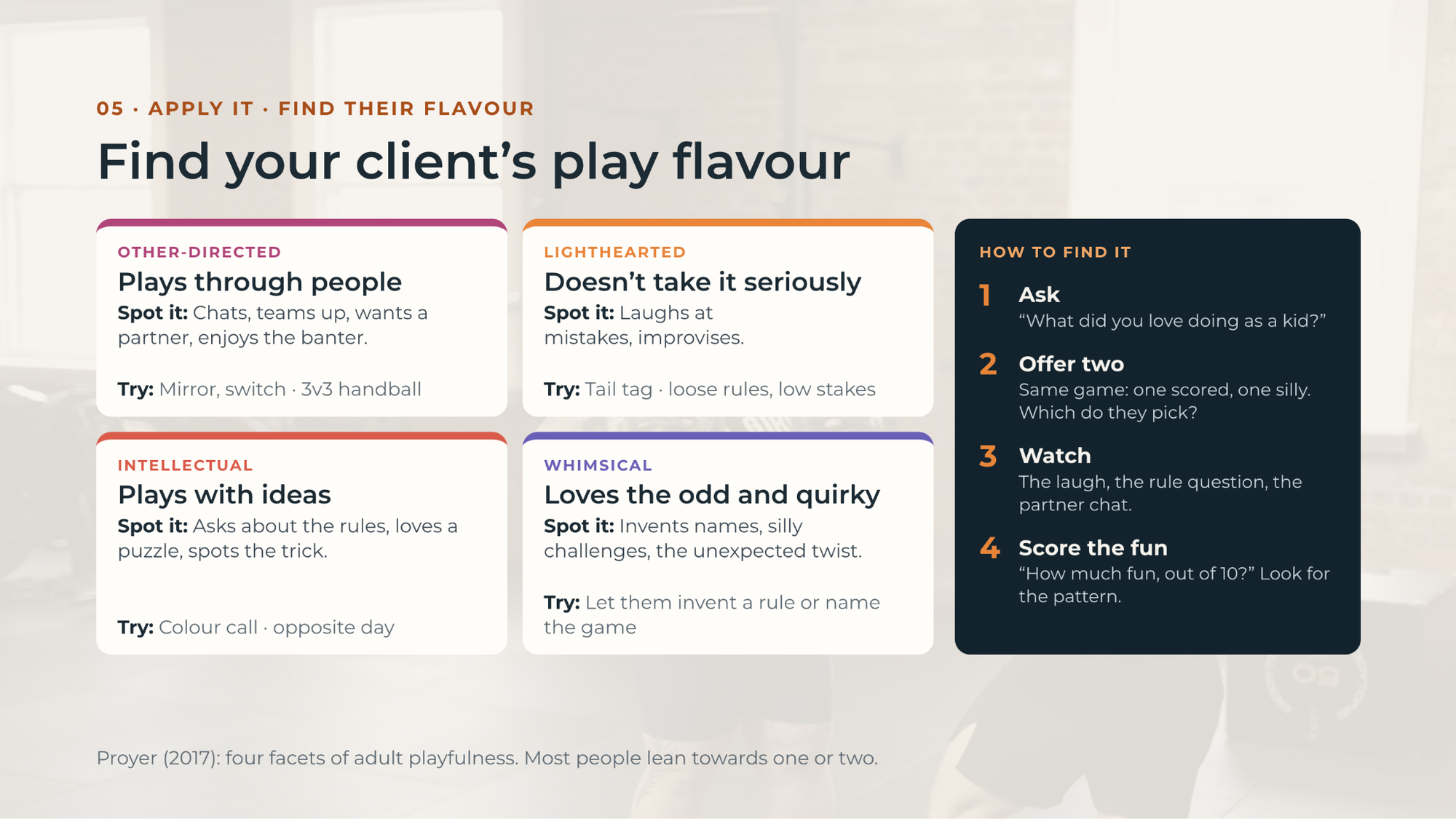
A client's story. Twenty years ago a client was handed over to me with a note from his previous trainer: inconsistent, may not be long term. We connected through sport. Every session now follows the same ritual: a game at the beginning, then the real work (heavy lifting plus conditioning), then another game to finish. Standardised rules. A "third umpire" for disputed calls. Always a handshake and a laugh at the end. Staff and members stop to watch and join the banter.
This client runs a big company and has a busy family. He did not keep turning up for two decades because of a programme. He kept turning up because it is a source of joy in his week. The workout is the healthy by product.
Make it stick: five things to try this week
- Rewrite your why. Swap a mirror goal for a capability goal: carry the groceries in one trip, deadlift your bodyweight, keep up with the kids.
- Protect the in session feeling. Finish on something you enjoy, not something you dread. That is the memory you will carry to next time.
- Anchor it. Same days, same time, same place for the next six weeks. Let the routine do the deciding for you.
- Find your people. Book with a coach you trust, join a group that knows your name, or recruit a partner who is a step ahead of you.
- Add one game. A finisher with a score, a challenge with a mate, a ball to chase. Take play seriously, and it will take care of the consistency.
The best programme in the world is the one you are still doing in ten years. See you on the floor.
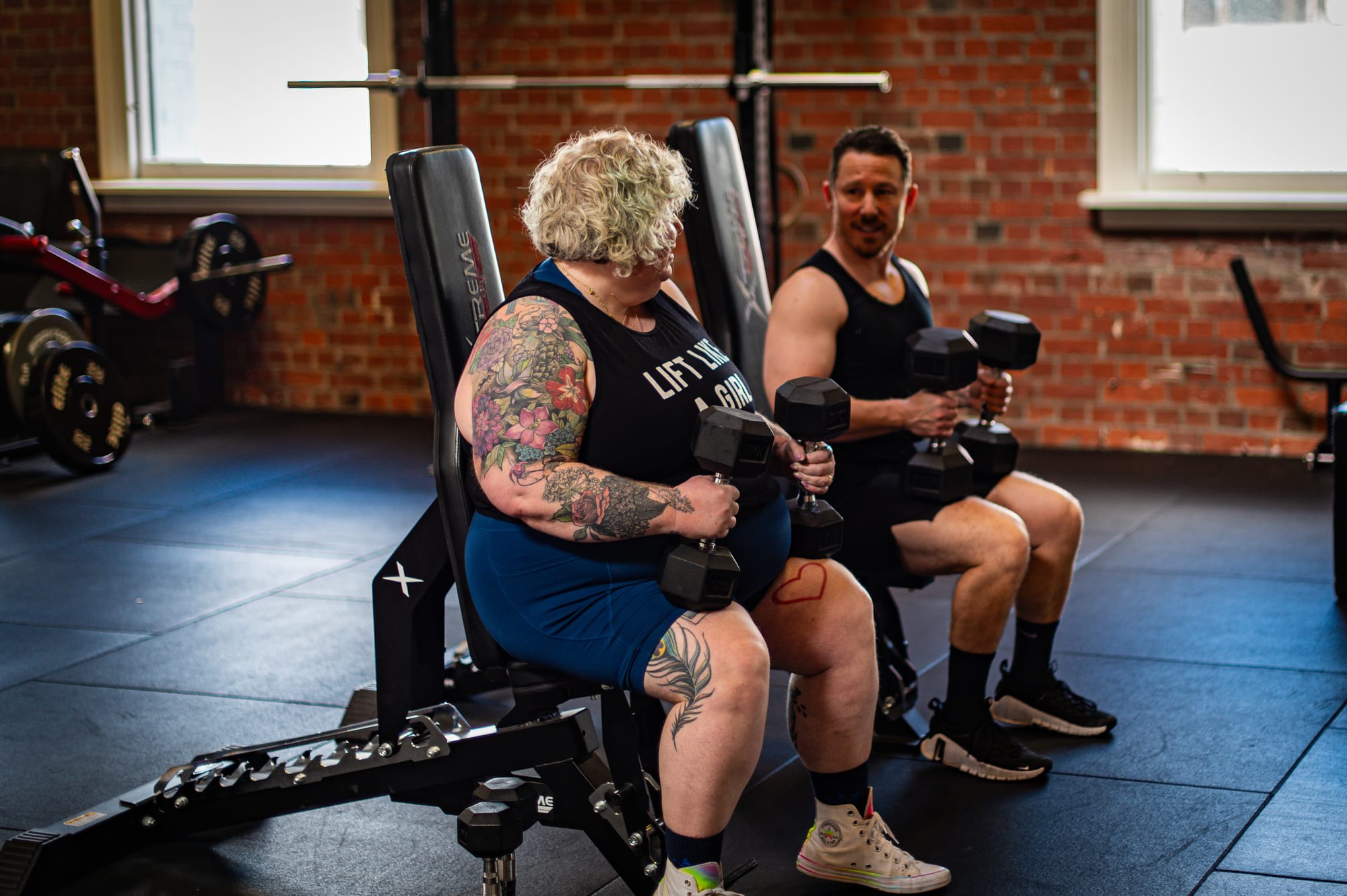
Megan here. If you asked me what I'm proud of in 2026, pretty high on the list would be "still being a person who goes to the gym despite, well, everything."
It's not just that I still go. It's that even in my worst times this year (bung knee, anxiety, unemployment, depression), it never occurred to me not to.
When Carl and I discussed this week's topic, I started thinking about why that is. What has changed about my life that makes skipping a session harder than just getting up and going?
Part of it is the community. Knowing that, even on a quiet day, there will be someone to chat to, commiserate with, or joke with feels good. This time last year, I accidentally described the Healthfit Christmas party as my work Christmas party, and while it's obviously not my place of employment, it fills a lot of the same social needs.
Then there's the voice in the back of my head that reminds me that if I go, I will feel better. I still hate that voice, but my grudging acceptance that it's right comes a lot quicker now.
Obviously, there's the knee rehab to do, and getting stronger around it. But old Megan would have (and did) put up with the pain. Old Megan would have assumed it couldn't get better, and even if she had miraculously done her physio exercises, she certainly wouldn't have been looping a resistance band round a couch leg in a holiday house so as to maintain her progress.
When I first started at the gym, I often worried about getting injured. Not because of the pain and inconvenience, but because what if I took a break and couldn't come back? This year I found out. I got hurt, and I came back. Actually, I never really left.
I've waxed lyrical so many times about how great being strong feels, and what a revelation it was to feel capable in my body. How lifting put me in my body and healed my trauma and made me more confident, to the point I am occasionally obnoxious. All of that is still true.
But nowadays, I don't need to find motivation. It's not that it's always easy. Some days it's much harder to get out of bed, when it's cold and dark and I know Carl is going to make me do Bulgarians. It's just that whether I go isn't really a question anymore.
People often ask me how to get there, and I have a few tips, which helpfully line up with all Carl's research.
- Get yourself a buddy. It might be a coach, it might be a friend, it might be that guy who lifts at the same time as you and grunts loudly, so you're determined to outlift him. But get someone who will notice if you're there and be pleased to see you, and who you can grimace at when your coach makes you do lunges.
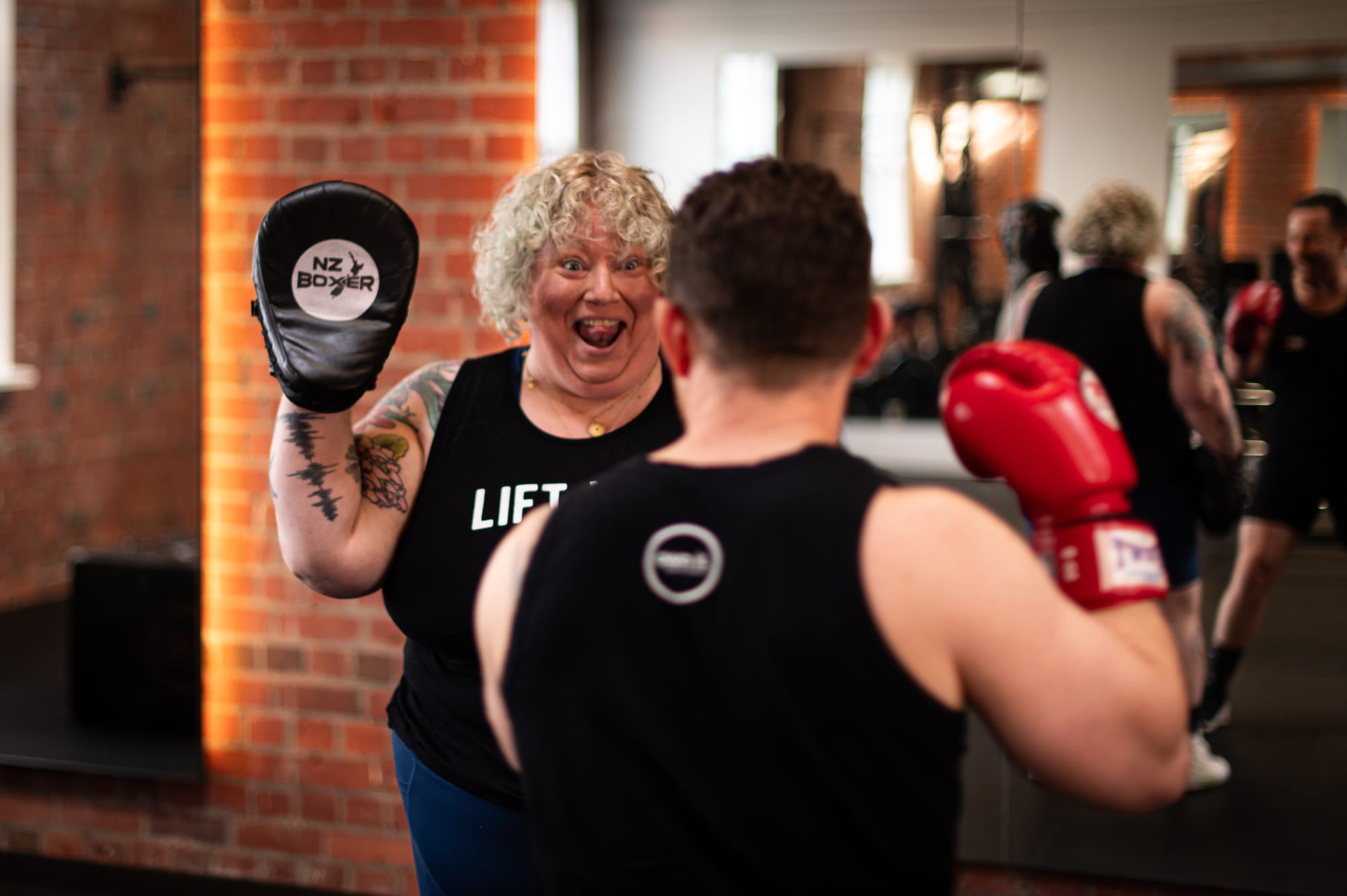
- Find an exercise that feels good. I've mentioned Bulgarians and lunges. I hate them both, but I would still much rather do them than run even 20 metres. My brain likes short bursts of really hard work, followed by three minutes' rest and then the same thing over again. That feels good to me, and that's OK. Chuck a silly experiment in there, and I will go home stoked.
- Find something that makes you feel like you. For me, feeling strong made my body match what my brain thought it should be. For you, it might be being really fast, or holding your breath underwater for ages, or hitting a ball really hard. Get that one, and then try new things to see how they feel.
Which brings me to my own buddy. There was a moment in a session this week where Carl and I were joking with another trainer, and then Carl gave me an instruction. I was briefly confused, and said out loud:
“I don’t know if I like it when you coach me.”
I send Carl reels of exercises for us to try. We text outside the gym, and I’ve had him and his family for dinner more than almost anyone else this year. He’s there when I need advice and when I am frustrated cos my body won’t do what I want it to do.
If you're lucky enough to be able to have a trainer, choose one who makes you laugh mid-set. And then go do the thing. Lift, run, throw, punch.
2016 Megan would roll her eyes so hard at all of this. But she also wore a lot of pre-ripped skinny jeans, and she definitely could not squat to depth.
I think that's the big difference. The party feels like my office party because lifting isn't just something I do, it's something I am. I'm gym Ken now. Ken's job isn't surfer, or lifeguard. It's just beach. My job (the one I don't get paid for) is just gym.
Actually, maybe I'm jacked Barbie. I would like that.