
Adapt, Don't Quit
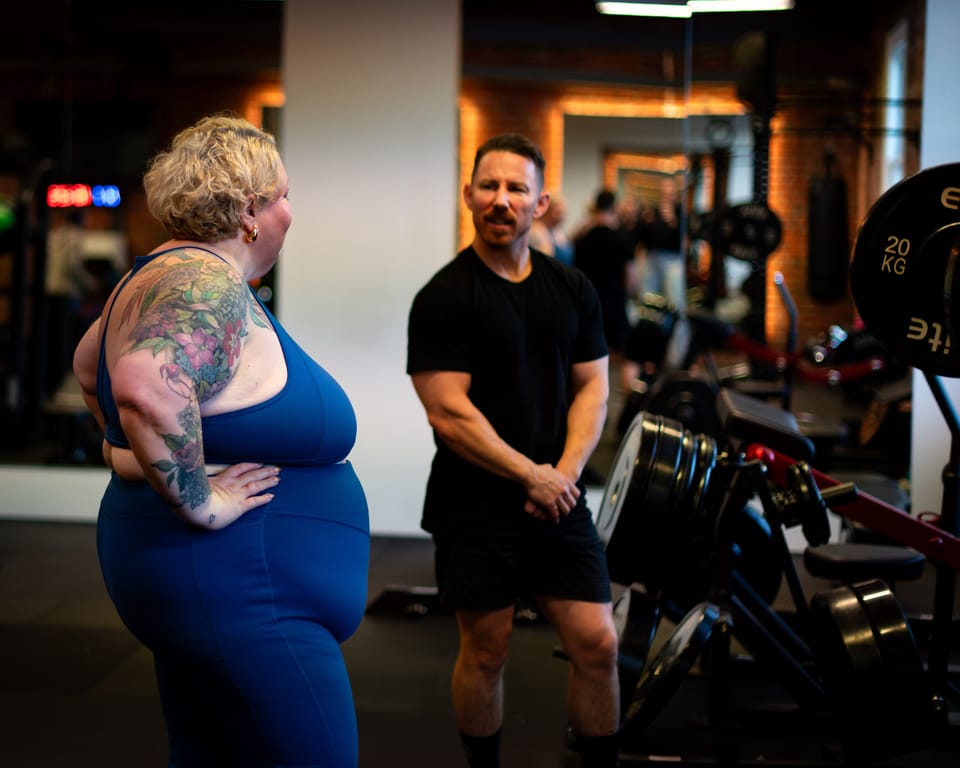
When I first started lifting, I learned that with all the many great things (strength, mobility, actually having a butt for the first time in my life) there were also some downsides.
- The sheer amount of laundry I do now.
- Constantly having to carry a gym bag with a belt, manky straps and various tubes of recovery ointment and chalk and gummy bears (for energy, I swear).
- So. Much. Greek. Yoghurt.
- Calluses.
- An uncomfortable level of body awareness - all the niggles, bruises and restrictions I was carrying.
Don’t get me wrong, lifting saved my relationship with my body, as I have written about many times. But knowing that I have an anterior humeral glide, and that’s why my pec feels less strong on one side than the other in my bench? I probably could have lived a long and contented life without ever needing to know that.
As a lifter, though, this is just data. It’s not a catastrophe, it’s just another thing to learn.
It tells me that I need to retract my shoulders more in my bench. That I need to do myofascial release before I lift. It helps Carl guide my shoulder accessories so that I can make the muscles around that joint stronger and better behaved.
Whether it’s a bruise from dropping a 20kg plate on your leg (true story), an inflamed knee or a dodgy pec that doesn’t cooperate under load, I am aware of all the niggles and bumps currently going on in my body. And I am either working with them, or around them, depending what they are.
Past me - the one who liked to pretend she was just a brain sitting atop a large bowl of porridge - used to feel these aches and, unless it was acute enough that she was actively limping, just hope they would go away. Or become part of the background hum of the body she pretended didn’t exist.
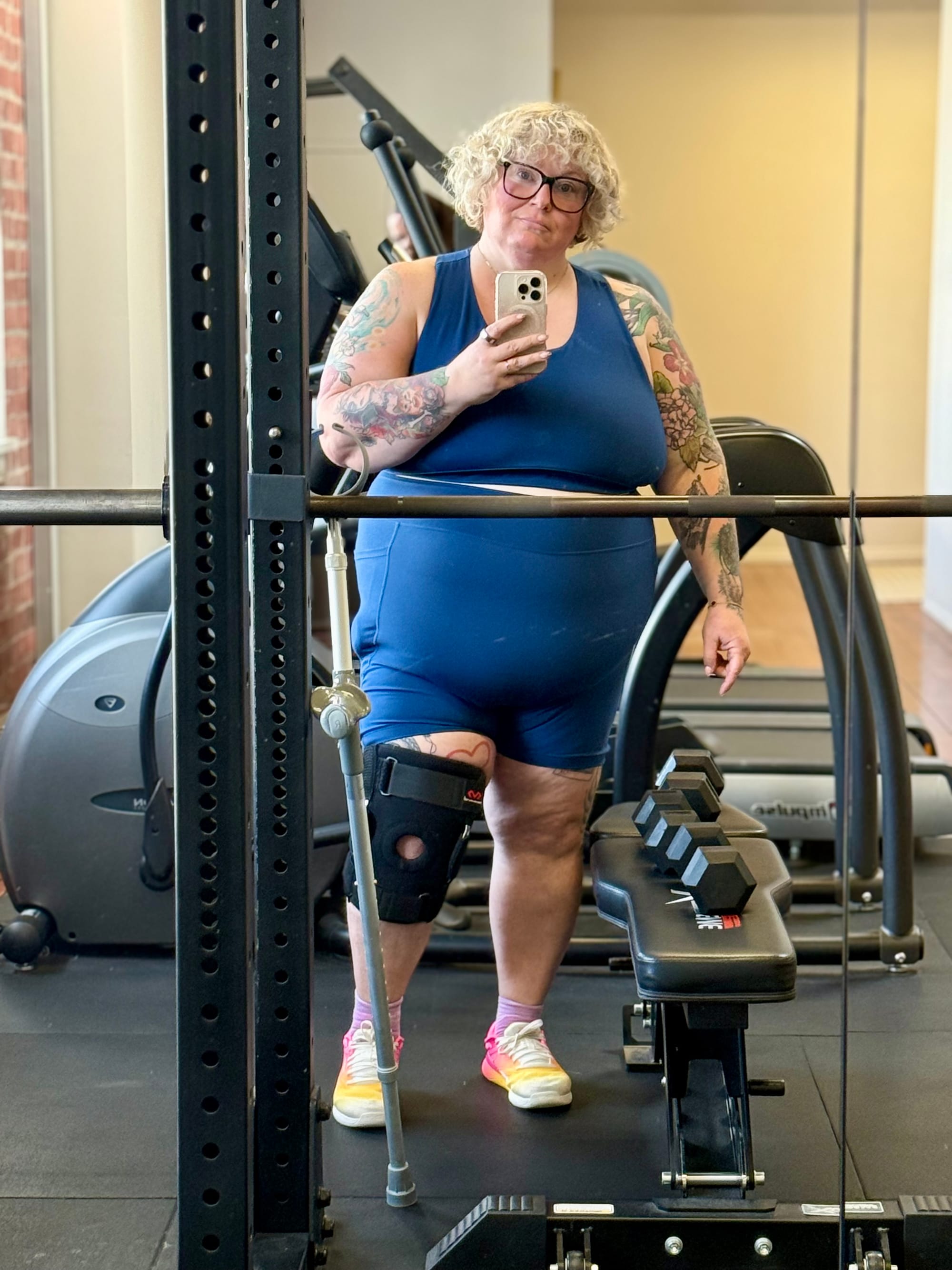
So even I was a little bit surprised to find myself, on Monday, in my favourite gym fit, balanced on one crutch, doing bicep curls while heavy metal blared in my earbuds.
“I have an excuse!” blared that part of my brain. I could sit on the couch for the next six weeks and do nothing, and call it healing. I could even cite “medical advice,” given the state of New Zealand’s healthcare system is such that I am yet to see a medical professional who can tell me what’s wrong and what I should be doing.
But I have learned enough about bodies to know that not moving at all would be far worse for me than the inconvenience of navigating how to swing my leg over an exercise bike so I can do single-leg cycling. (Carl’s idea. I remain unconvinced.)
I know this has less to do with keeping up my cardio fitness or chasing PRs. It’s about my brain.
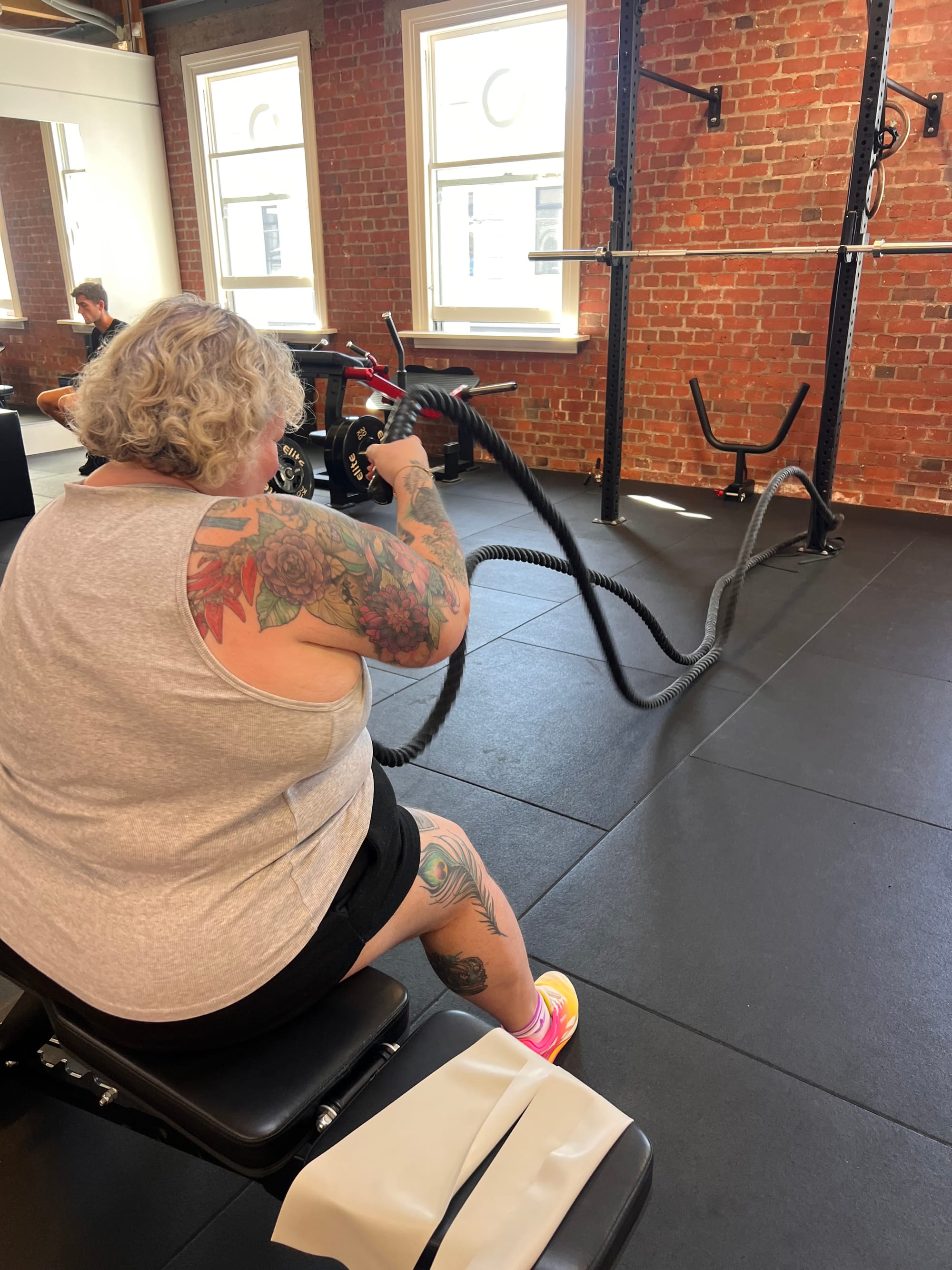
I told Carl I was in a bad mood and wanted to sweat. So he got out the battle ropes. Seated battle ropes, shoulder raises, seated pulls. I can grudgingly admit I felt better. The gym isn’t just for my body. It’s also for my mental health.
The other part is reminding my nervous system that I have muscles and they work. That my shoulder can still generate force. That my leg can still move blood and heal itself. Not ignoring the pain or pretending nothing is wrong. But not teaching my brain that I am made of fragile, breakable glass.
As we’ve talked about already this year, pain is not just a signal of damage; it’s a protective output. My nervous system is constantly running a risk assessment, weighing load, context, stress, sleep, mood, history, and deciding how loud an alarm needs to sound.
Moving - within reason - updates that risk framework. It helps tell my brain that it’s safe to let go. Which in turn, helps me to also let go. Of the frustration and the fear.
I don’t love knowing the name for every niggle. But I love knowing I can do something about them. I love learning new and fun ways to challenge my body, and workarounds for the bits that are still too hard.
My before and after was never going to be a side-by-side photo. Changing my body was never the point.
My before and after is simpler than that. There is before I rediscovered the joy of moving my body — and after.
It’s learning that my body was never a problem to solve. It was a relationship to invest in. My body adapts to what I repeatedly show it. And every time I turn up at the gym, I am showing it what we’re capable of.
Carl here
This is so relatable. There's a common misconception that when you start training and getting fit, injuries and pain will cease to exist! This just isn't the case, in fact it's a normal part of the physical journey, and again, the benefits faaaar outweigh these injuries. We will unpack the journey, add some science and give you a framework and some tools to work with. This will not only help with your rehab, but may also keep some conditioning momentum and remind you that you are still capable.
We’ve already covered pain science and progressive overload in previous editions, so I won’t revisit those in depth here. Instead, I want to hone in on the real heartbeat of Megan’s story: she turned up on crutches and trained anyway and not recklessly or ignorantly! Despite Megan being left in the dark with the medical system, she took action and found a way to sweat and remind herself that she is still a superhero!
In most non-catastrophic musculoskeletal injuries, complete rest is rarely the most effective strategy. For common issues such as tendinopathy, non-specific low back pain, patellofemoral pain and many shoulder presentations, research consistently supports graded activity is far more effective over prolonged immobilisation. Tissues respond to load. Remove load entirely and capacity drops. Maintain appropriately scaled load and the system retains strength, coordination and resilience. Translating to, you are going to do far better if you find a way to keep moving!
What actually happens at the microscopic level?
Muscle contraction increases circulation, supporting nutrient delivery and tissue remodelling. Tendons and cartilage in particular respond better to progressive loading than to total unloading. At the same time, the nervous system benefits from safe, controlled movement. As we have discussed previously, pain is a protective output. When you move within tolerable limits, you provide evidence to the brain that the body is capable. Over time, this can reduce sensitivity and improve tolerance. Meaning we should lean into that statement from last weeks newsletter ‘confidence should slightly outweigh your ability’ at the moment.
There is also a mental health layer that is impossible to ignore. Resistance and aerobic exercise are both associated with reductions in depressive symptoms, as shown in large meta-analyses such as Gordon et al., 2018. When injury removes all movement, it often removes routine, identity and stress regulation as well. Preserving some form of training protects more than muscle. It protects mood and momentum. So if Megan were to stop, she may be at risk of losing her Torque identity! But that was never going to happen, as Megan's secret superpower is grit.
The key is not pushing through blindly. It is intelligent modification.
When working around an injury, the first question is not “What can’t I do?” It is “What can I still train effectively?” If the ankle is irritated, the upper body can still work hard. If the shoulder is flared up, lower body loading is still available. If one limb is compromised, the other can often train normally, and interestingly, there is evidence for cross education effects where training one limb can help preserve strength in the other through neural mechanisms = the justification for single leg cycling!
The second layer is changing the expression of the movement. This is where seated battle ropes and shoulder circuits matter. A lower limb injury does not eliminate conditioning. It changes how you approach it. Seated ropes, single leg cycling, upper body hypertrophy blocks and core circuits all maintain effort relative to capacity. If the shoulder is irritated, perhaps heavy barbell benching is temporarily replaced with reduced range dumbbell pressing, floor presses, slower eccentrics, or increased focus on shoulder blade movement (to work on that scapular humeral rhythm!). You are not abandoning the pattern. You are scaling load, range, speed or volume to match current tolerance.
Some useful questions to ask:
- Is the discomfort tolerable?
- Does it settle within twenty four hours?
- Are you still training something meaningfully hard?
If those boxes are ticked, you are likely operating in a productive zone. If symptoms escalate and linger, you can adjust. You do not quit entirely.
There is also a powerful psychological shift that occurs when you train around an injury rather than withdrawing completely. Each successful session reinforces the message that you are adaptable, not fragile. That your body can still generate force. That capacity is dynamic. This changes behaviour. And behaviour drives long term outcomes.
From an inclusivity perspective, this matters deeply. One of the biggest misconceptions in fitness is that you must be pain free, symmetrical and fully “fixed” before you deserve to train. The reality is that asymmetries are common, minor niggles are common, and capacity is trainable at almost every stage of life. You do not need a perfect starting point, you don't need to move a certain way and you certainly don't need to look a certain way!
The real before and after is not aesthetic. It is conceptual. Before, perhaps an injury meant stop. Now, an injury means adapt. That shift protects tissue, protects mental health, and keeps you in the game long enough for biology to do what it does best, which is respond to repeated, appropriate stimulus.
Yes, the laundry increases. The yoghurt consumption escalates. The gym bag gets heavier. But so does your capacity. And that is a trade worth making.
Keep moving, there is always a way, find a coach or physio to help guide this and please keep playing!